Updated: September 12, 2025
What Is EMA in Crypto Trading? A Practical, Comprehensive Guide
The Exponential Moving Average (EMA) is one of the most used indicators in crypto trading. It’s a running average that gives more weight to recent prices, so it reacts faster than a simple moving average (SMA). Traders use EMAs to identify trend direction, time entries/exits, trail stops, and build systematic strategies like the EMA crossover. Below you’ll find the definition, the math, how to configure EMAs for different timeframes, signal rules that actually hold up, and a step-by-step plan to backtest and execute on BYBIT, BITGET, and MEXC.
Definition: EMA vs SMA (and why crypto prefers EMA)
A moving average smooths price data to reveal trend direction. The EMA gives exponentially more weight to the most recent candles, while the SMA weights all candles equally. Because crypto trades 24/7 with frequent momentum bursts, EMA’s faster response helps traders catch trend shifts sooner and manage risk tighter.
EMA Formula & How It’s Calculated
EMAtoday = α × Pricetoday + (1 − α) × EMAyesterday
Seed: Many charting tools start EMA with the SMA of the first n periods.
Shorter n values (e.g., 9) track price closely but whipsaw more; longer n values (e.g., 200) lag but better define the big trend.
Popular EMA Settings & What They Do
| Length | Intent | Typical Use |
|---|---|---|
| 9 / 10 | Very fast | Scalping/intraday momentum; early pullback buys |
| 12 & 26 | Balanced pair | MACD-style crossover core |
| 20 | Short-term trend | Dynamic trailing stop on 1h–4h |
| 50 | Intermediate trend | Pullback zone on 4h–1D |
| 200 | Major regime | Bull vs bear filter on 1D/1W |
Core Use Cases: Trends, Pullbacks, Trailing Stops
1) Trend direction
Price above a rising 200 EMA = long-term bullish bias; below a falling 200 EMA = bearish bias.
2) Pullback entries
In an uptrend, look for price to retrace toward the 20/50 EMA, then resume upward with supportive volume/structure.
3) Dynamic trailing stops
Trail partial or full positions with the 20 or 50 EMA. If price closes decisively on the wrong side, exit.
EMA Crossover Basics
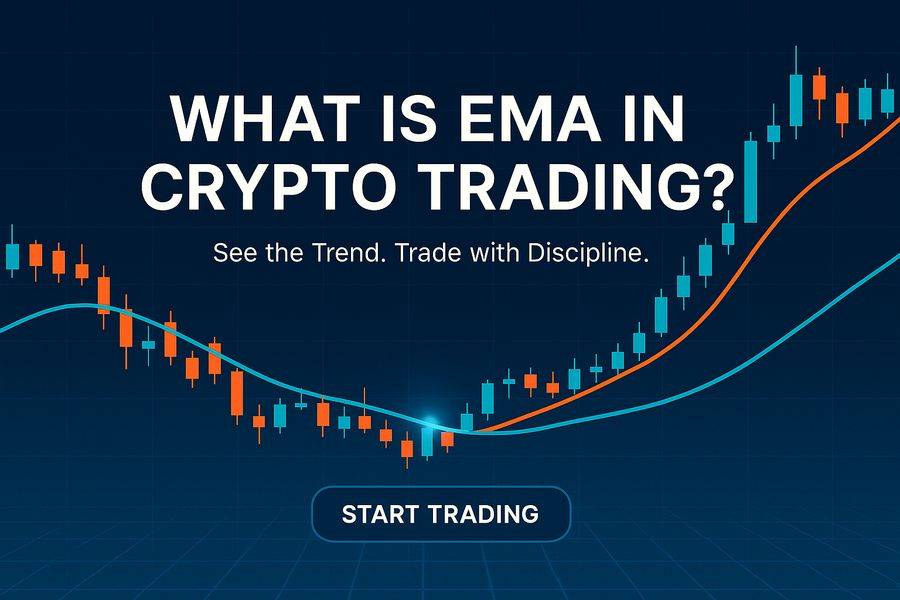
A bullish crossover occurs when a fast EMA (e.g., 9/12/20) closes above a slow EMA (e.g., 21/26/50); the opposite is bearish. Crossover strategies are simple, repeatable, and easy to automate—but they can overtrade in sideways markets. Consider adding filters (next section).
Filters That Improve EMA Signals
- Regime filter: Trade long signals only when price is above a rising 200 EMA; short only below a falling 200 EMA.
- Volatility gate: Require ATR above a rolling median to avoid dead ranges.
- Structure breakout: Prefer crosses that occur with a higher-high/lower-low confirmation.
- Session timing: For intraday, trade during high-liquidity overlaps; avoid the quietest hours.
Risk Management with EMAs
| Control | Practical Setup | Why |
|---|---|---|
| Position size | Risk 0.5–1.5% of equity/trade; scale by ATR | Survives losing streaks |
| Stops | Below/above swing level or 1.5–2.5× ATR | Defines invalidation |
| Daily loss cap | Pause after −3R or −3 losers | Protects mental capital |
| Slippage control | Use limit/TWAP in thin pairs | Hidden costs matter |
| Diversification | Mix pairs/timeframes, avoid correlation piles | Smoother equity curve |
Timeframes & Market Selection
EMAs work across charts, but success depends on trendiness and liquidity. On BTC/ETH, many traders prefer 1h–4h–1D. On smaller alts, 4h–1D helps reduce noise. For scalping, 5–15m can work during liquid sessions, but expect more whipsaws and higher fee/impact sensitivity.
How to Backtest an EMA Strategy (Checklist)
- Define: Pairs, timeframe, EMA lengths, entries/exits, stops/targets.
- Split: In-sample (design) vs out-of-sample (validation).
- Model costs: Taker/maker fees, funding (perps), and realistic slippage.
- Metrics: CAGR, max DD, Sharpe/Sortino, win rate, avg R, exposure time.
- Sensitivity: Test nearby EMA values; robust systems shouldn’t depend on one magical pair.
- Walk-forward: Re-validate quarterly; avoid over-tuning.
- Go live small: Paper trade or run tiny size for 2–4 weeks; then scale gradually.
Execution Tips on BYBIT, BITGET, MEXC
| Platform | Why Traders Use It | EMA Tips | Start |
|---|---|---|---|
| BYBIT | Deep perp liquidity, advanced order types | Set TP/SL on entry; try Post-Only for maker rebates; use 20/50 EMA for trailing | Trade on BYBIT |
| BITGET | Strategy tools & copy-trading options | Automate 9/21 or 12/26 via bots; test filters on 1h/4h | Start on BITGET |
| MEXC | Broad alt coverage for momentum rotations | Prefer 20/50/200 EMA stack on 4h/1D to tame volatility | Explore MEXC |
FAQ
What does EMA stand for in crypto trading?
EMA stands for Exponential Moving Average, a moving average that emphasizes recent prices to react faster to market changes.
What’s the difference between EMA and SMA?
EMA weights recent candles more, so it reacts faster; SMA weights all candles equally and is smoother but slower.
Which EMA length is best?
No single best. 9/10 are fast; 12/26 are balanced; 20/50 track trends; 200 defines the long-term regime. Test on your pairs/timeframe.
Are EMA crossovers profitable?
They can be in trending markets with proper filters and risk controls. Costs (fees, slippage, funding) must be modeled.
Can I use EMAs for trailing stops?
Yes—many traders trail with the 20 or 50 EMA and exit on a decisive close against the trend.
Glossary
- EMA: Exponential Moving Average, weights recent prices more.
- SMA: Simple Moving Average, equal weights.
- ATR: Average True Range; a volatility measure used for stops/filters.
- Crossover: Fast EMA crossing a slower EMA to signal possible trend change.
- R-Multiple: Profit/Loss relative to initial risk per trade.
Disclaimer: This guide is educational and not financial advice. Crypto and derivatives involve risk; only trade what you can afford to lose.