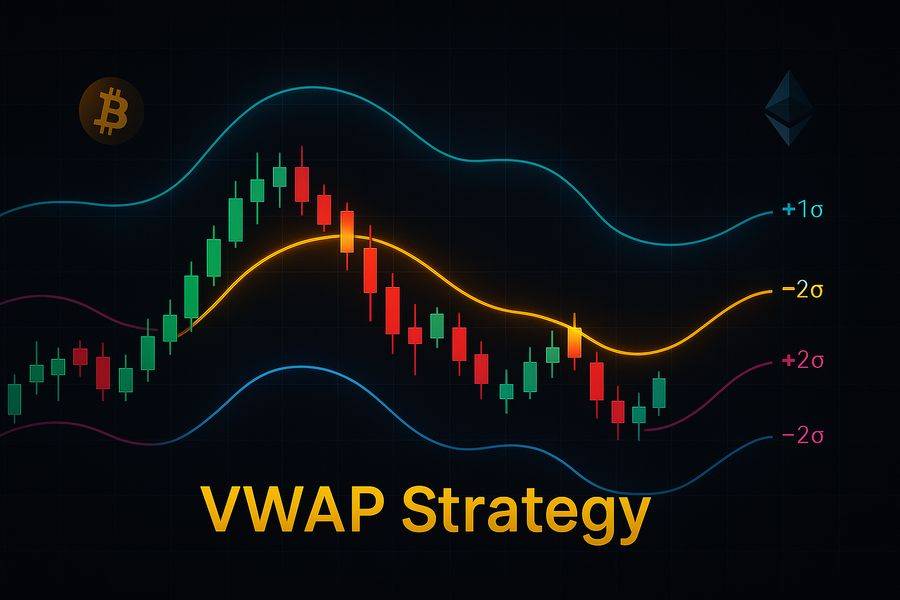
VWAP Strategy in Crypto: The Complete, Actionable Guide
Master Volume-Weighted Average Price (VWAP) to sharpen entries, exits, and risk in volatile crypto markets.
What Is VWAP?
The Volume-Weighted Average Price (VWAP) is a rolling benchmark that calculates the average price of an asset weighted by traded volume over a defined session. In practice, it answers a simple question: At what price did the majority of volume change hands? Day traders and algorithms use VWAP to gauge fair value and directional bias.
VWAP resets on a defined period (most often the daily session) and is plotted as a single line. When price is above VWAP, buyers have an edge over the session; when below, sellers dominate. In crypto, where liquidity is fragmented and volatility is high, VWAP helps filter noise and anchors trades to institutional-style execution logic.
Why VWAP Works in Crypto
1) Session “Fair Value” Amid 24/7 Trading
Crypto never closes, but liquidity still clusters around certain hours (U.S. and EU trading overlaps). VWAP offers a daily “fair value” anchor even in a continuous market, making it easier to spot premium/discount zones intraday.
2) Execution Benchmark Followed by Pros
Market makers and large traders benchmark their execution to VWAP to reduce slippage. That feedback loop can make the line self-reinforcing: price often reacts at or near VWAP, creating tradeable bounces and reversion opportunities.
3) Filters Whipsaw
Because VWAP is volume-weighted, it adapts to genuine activity better than simple moving averages. In choppy crypto pairs, VWAP can reduce false signals by ignoring low-volume pushes.
Core VWAP Strategies (Crypto)
A) VWAP Mean Reversion (“Touch & Go”)
Look to fade stretched moves back into VWAP. Identify an impulsive leg away from VWAP, then wait for a loss of momentum (e.g., lower high on LTF if price extended above VWAP). Enter toward the VWAP “magnet,” target partials at VWAP, and leave a runner for a potential cross to the other side.
B) VWAP Trend-Following with Pullbacks
In a directional day, buy pullbacks when price retakes VWAP from above (bull bias) or sell rallies when price retests VWAP from below (bear bias). Confirmation can come from structure (HH/HL or LH/LL) and rising/falling cumulative delta.
C) VWAP Band/Deviation Strategy
Apply standard-deviation bands around VWAP (e.g., ±1σ and ±2σ). In range days, fade ±1σ extremes back to the mean; in trend days, use ±1σ as a dynamic pullback area and ±2σ for profit taking.
D) Multi-Session VWAP (Rolling)
Anchor VWAP to multiple sessions (e.g., weekly and monthly) to map higher-timeframe value. Intraday trades aligned with the direction of higher-timeframe VWAP often have better follow-through.
Entries, Exits & Risk Rules
Entry Triggers
- Retest & Reject: Price reclaims VWAP, then pulls back to test it from above (bull) or below (bear); enter on the first sign of rejection (wick, absorption, or structure break).
- Deviation Tag: Enter at ±1σ or ±2σ with order-flow confirmation when mean reversion is likely (low-trend context, overlapping profiles, balanced volume).
- Micro-Structure: Use a 1–5m break of structure to refine risk after VWAP interaction.
Exit & Targets
- First Target: VWAP touch (for mean reversion) or opposite deviation band (for trend days).
- Trail: Behind last swing or via ATR(14) on the entry timeframe.
- Time-Based: Flatten before low-liquidity hours or major data events that impact BTC/USDT pairs.
Risk Management
- Risk per trade: 0.25–1.0% of account. Crypto’s leverage tempts over-sizing—don’t.
- Place stops beyond structure, not just beyond the VWAP line. If long on VWAP retest, stop below the swing low formed during the retest.
- Scale-in only on fresh confirmation (e.g., second reclaim + higher low); never average into losers.
Timeframes, Sessions & Instruments
Timeframes
VWAP is most effective intraday (1m–15m execution, 30m–1h context). For swing trades, use anchored VWAP from a significant pivot or event (listing, FOMC day, halving).
Sessions
Even in 24/7 crypto, liquidity peaks during EU and U.S. overlaps. Many traders reset VWAP at 00:00 UTC; others prefer exchange server reset (e.g., Binance 00:00 UTC). Be consistent across your charts and backtests.
Markets
Works on spot, perpetual futures, and majors (BTC, ETH) as well as liquid alts. Thin pairs can distort VWAP; avoid where 1–5m candles often have near-zero volume.
Combining VWAP with Other Indicators
Anchored VWAP (AVWAP)
Anchor from a key high/low or news bar to identify persistent value zones. Confluence of Daily VWAP and a major AVWAP often defines A+ trade areas.
EMA Cloud
Use a fast EMA (e.g., 9/21) for momentum confirmation. For trend trades, prefer entries when price is above VWAP and above rising EMAs (or below both for shorts).
RSI or Stoch
Momentum divergences at deviation bands (±1σ/±2σ) can time mean-reversion entries with tighter risk.
Volume Profile / Market Profile
Confluence between VWAP and HVNs/LVNs improves location. A VWAP retest into an LVN often yields strong continuation when accepted back through the level.
Backtesting & Optimization
Data & Definitions
- VWAP Reset: Daily at 00:00 UTC or exchange midnight—document which you use.
- Deviations: Start with ±1σ and ±2σ based on intraday volume distribution.
- Markets: BTCUSDT perp and 1–3 liquid alts; avoid illiquid pairs.
Objective Rules Example
// Long (Trend-Pullback)
Context: Price above Daily VWAP & above rising 21 EMA (5m).
Trigger: Pullback tags VWAP or +1σ → bullish reversal candle + break of micro-structure high.
Stop: Below pullback low.
TP1: Prior swing high or +2σ; TP2: trail via ATR(14) or last 5m swing.
Metrics to Track
- Win rate, average R, max drawdown, edge by session (EU/US/Asia), performance by day type (trend vs range).
- Slippage & fees sensitivity (perps funding, maker/taker).
Forward Testing
After a 3–6 month sample, forward test live with reduced size. Validate that the edge persists across regimes (high/low volatility, BTC trend/sideways).
Common Mistakes to Avoid
- Trading every touch: VWAP is a level, not a signal. Demand context and confirmation.
- Ignoring liquidity regime: Overnight Asia hours often have thinner books; adjust expectations and targets.
- Over-optimizing deviations: Don’t curve-fit σ bands to history; keep parameters robust.
- Inconsistent reset times: Backtests break if your live charts use a different VWAP session than your historical test.
VWAP Trade Checklist (Copy/Paste)
- What’s the day type? (trend / range)
- Where is price vs Daily VWAP, Weekly VWAP, and key AVWAPs?
- Do we have confluence (EMA trend, profile levels, divergence)?
- Is the entry a reclaim/retest or a deviation fade?
- Defined stop beyond structure? Risk ≤ 1%?
- TP plan (VWAP, ±σ, swing levels) + trailing logic?
- Session/volatility fit? (EU/US overlap preferred)
FAQs
Is VWAP better than moving averages in crypto?
Different tool, different job. VWAP reflects where most volume has traded during the session, making it a superior intraday value anchor. EMAs are better for pure momentum trend filtering.
Which VWAP deviations should I use?
Start with ±1σ and ±2σ. If your market is unusually volatile, widen bands; if very quiet, narrow slightly. Validate with backtesting, not guesswork.
Does VWAP work for swing trades?
Use anchored VWAP from key pivots or events for multi-day context, then time entries on intraday pullbacks to the daily VWAP or AVWAP confluence.
What about funding and fees on perps?
Fees can turn small edges negative. Favor maker entries where possible, and include fee/funding assumptions in your backtests.