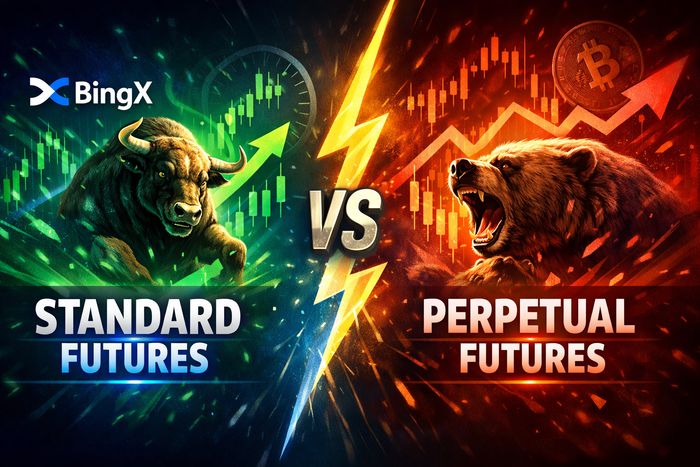
BingX Standard Futures vs Perpetual Futures 2026: Full Guide & Comparison
BingX Standard Futures vs Perpetual Futures 2026: The Ultimate Showdown
Educational content only. Not financial advice. Always conduct your own research before trading.
📌 Key Takeaways: BingX Standard vs. Perpetual Futures
- Standard Futures have an expiry date (quarterly or monthly). Perpetuals do not—you can hold them indefinitely [citation:1].
- Funding fees are the main differentiator: Perpetuals use funding rates to track the spot price; Standard futures have no funding fees, but their price converges with the spot price at expiry [citation:1][citation:4].
- Leverage is identical: Both offer up to 125x on BTC/ETH and 50x on altcoins [citation:1].
- 2026 Update: BingX now offers TradFi Perpetuals on forex, commodities (Gold, Oil), stocks (TSLA, MSFT), and indices (S&P 500) with up to 500x leverage [citation:4][citation:5][citation:7]. Standard futures remain crypto-only.
- Hidden Cost Alert: The „rollover cost” of standard futures (closing and reopening a new contract) can sometimes exceed the cumulative funding fees of a perpetual position. We break down the math.
1. Why the Standard vs. Perpetual Decision Matters More in 2026
In 2026, BingX offers one of the most diverse futures lineups in the industry. You can trade standard futures with fixed expiry dates, perpetual futures with no expiry, and even TradFi perpetuals that track gold, oil, stocks, and forex [citation:4][citation:5]. But for most traders, the core question remains: BingX standard futures vs perpetual futures—which one should you use?
The answer isn’t one-size-fits-all. Standard futures are predictable: no funding fees, but they expire. Perpetuals offer flexibility: you can hold them forever, but you pay (or receive) funding every 8 hours [citation:1][citation:4]. This guide strips away the marketing fluff. We cover the exact costs, the „rollover trap,” three concrete templates, and real user feedback to help you decide.
What Traders Are Saying in 2026:
“I use BingX perpetuals for BTC because I never know when I want to exit. The funding fees are manageable if you check the rate before entering. For altcoins, I prefer standard futures around major events—no funding surprises.” — Marco, derivatives trader
“The new TradFi perpetuals on BingX are a game-changer. I can hold Gold positions indefinitely without worrying about contract expiry. But for my ETH plays around ETF dates, standard futures feel safer.” — Elena, macro trader
“BingX copy trading is mostly on perpetuals, which makes sense because you don’t want your copied trader’s position to expire while you’re not looking. The platform’s demo account helped me understand funding before going live.” — Sam, copy trader [citation:1]
2. At-a-Glance: BingX Futures Scorecard (2026)
| Feature | Standard Futures | Perpetual Futures |
|---|---|---|
| Expiry Date | Yes (quarterly/monthly) [citation:1] | No [citation:1] |
| Funding Fees | None | Every 8 hours (to track spot) [citation:4] |
| Max Leverage (Crypto) | 125x (BTC/ETH), 50x (altcoins) [citation:1] | 125x (BTC/ETH), 50x (altcoins) [citation:1] |
| Max Leverage (TradFi) | Not available | Up to 500x (forex/indices), 25x (stocks) [citation:4][citation:7] |
| Settlement | USDT or Coin-M [citation:1] | USDT-M or Coin-M [citation:1] |
| Trading Pairs | ~500 crypto pairs [citation:1] | 500+ crypto + 50+ TradFi assets [citation:1][citation:5] |
| Copy Trading | Not typically used | Widely supported [citation:1] |
3. „Best For” Use-Case Table
| Trader Type | Standard Futures | Perpetual Futures |
|---|---|---|
| Event-Driven Traders | ✅ Ideal for trading halving, ETF dates, or news events with a known end date. | ❌ Funding fees can erode profits if the event is delayed. |
| Long-Term Hodlers | ❌ Must roll over contracts quarterly, incurring costs and taxable events. | ✅ Can hold indefinitely, subject to funding [citation:1]. |
| Copy Traders | ❌ Rarely used in copy trading due to expiry complexity. | ✅ The standard for BingX copy trading [citation:1]. |
| Macro / Commodity Traders | ❌ Not available for TradFi. | ✅ Access Gold, Oil, S&P 500 with high leverage [citation:4]. |
| Scalpers / Day Traders | ✅ No funding fees for ultra-short holds. | ✅ Also suitable, but funding negligible for <8h holds. |
4. Deep Dive: Standard Futures vs. Perpetuals
4.1. What Are Standard Futures on BingX?
Standard futures are contracts with a fixed expiry date—typically quarterly or monthly [citation:1]. When you buy a standard futures contract, you agree to buy the underlying asset at a predetermined price on a specific future date. On BingX, these settle in USDT or the base asset (e.g., BTC) [citation:1].
Key Characteristic: The price of a standard futures contract converges with the spot price as expiry approaches. There are no funding fees, but you cannot hold the position past the expiry date unless you „roll over” by closing the current contract and opening a new one [citation:1].
4.2. What Are Perpetual Futures on BingX?
Perpetual futures have no expiry date [citation:1]. To keep their price anchored to the spot market, they use a funding rate. Every 8 hours, longs pay shorts (or vice versa) based on the difference between the perpetual contract price and the spot price [citation:4]. On BingX, you can trade over 500 crypto perpetuals and, as of January 2026, over 50 TradFi perpetuals including forex (EUR/USD), commodities (Gold, Oil), stocks (TSLA, MSFT), and indices (S&P 500) [citation:4][citation:5][citation:7].
Key Characteristic: You can hold a perpetual position forever, as long as you meet maintenance margin requirements and manage funding costs [citation:1].
5. Fees, Funding & Expiry: The Core Differences
- Trading Fees (both): Maker 0.02% | Taker 0.045% for futures [citation:1]. TradFi perpetual fees may vary by region, but generally follow the same structure [citation:6].
- Funding Fees (perpetuals only): Exchanged every 8 hours. The rate depends on the premium between the perpetual and spot price. Always check the „Funding Rate” tab before entering [citation:4].
- Expiry (standard only): Standard futures expire. You must close or roll over your position before expiry to avoid automatic settlement [citation:1].
- Liquidation Risk (both): Both use tiered maintenance margin. Larger positions require higher maintenance margin % [citation:1].

7. 3 Ready-to-Use Trading Templates
These are strategic frameworks. Adjust size to your risk.
Template A: The „Halving Run-Up” (Budget: $3,000 USDT)
Goal: Profit from Bitcoin’s price increase leading to the next halving (known event date).
- Instrument: Standard Futures (Quarterly BTCUSDT).
- Rationale: No funding fees during the hold period. You only pay the spread and trading fees. The known end date aligns with the event.
- Position: Long 1 contract with 3x leverage ($9,000 exposure).
- Entry: Limit order at support level.
- Exit: 2 weeks before expiry (to avoid volatility and rollover).
Template B: The „Gold Hedge” (Budget: $2,000 USDT)
Goal: Hedge against inflation by holding Gold indefinitely.
- Instrument: TradFi Perpetual Futures (Gold/USDT) [citation:4].
- Rationale: No expiry, so you can hold as long as you want. Leverage up to 500x, but use low leverage (5x) for a long-term hold.
- Position: Long with 5x leverage ($10,000 exposure).
- Funding Management: Set a calendar reminder to check funding rates weekly. If funding turns strongly positive (you pay), consider reducing size or switching to a standard contract if available.
Template C: The „Altcoin Event Play” (Budget: $1,000 USDT)
Goal: Trade an altcoin (e.g., LDO) around a major upgrade or token unlock event [citation:3].
- Instrument: Standard Futures (if available) or Perpetuals with tight risk control.
- Rationale: Altcoin perpetuals can have extreme funding rates during hype. Standard futures avoid this, but may have lower liquidity.
- Position: Long with 2x leverage ($2,000 exposure).
- Risk Note: BingX periodically delists low-liquidity futures [citation:9]. Ensure your altcoin pair is actively traded and not on the „watch list.”
8. Methodology: How We Evaluate BingX Futures
Our evaluation is based on 6 pillars:
- Fee Transparency: Cross-referencing maker/taker schedules with real executed trades [citation:1].
- Funding Rate Analysis: Historical funding data to estimate long-term holding costs [citation:4].
- Liquidity Depth: Using live order book data for major and minor pairs [citation:1].
- Hidden Cost Audit: Calculating rollover vs. funding costs using the formula above.
- Product Uniqueness: Assessment of TradFi perpetuals and copy trading integration [citation:1][citation:5].
- Risk Infrastructure: Review of maintenance margin tiers, insurance fund, and delisting policies [citation:9].
9. Common Problems & Fixes for BingX Futures Traders
- Problem: „I was liquidated on a perpetual even though I had margin.”
Fix: You hit the Maintenance Margin tier. For large positions, the maintenance margin % increases. Always check the tiered table before opening [citation:1]. - Problem: „Funding fees on my altcoin perpetual are eating my profits.”
Fix: Check the funding rate history. If it’s consistently positive (longs pay), consider using standard futures for that asset, if available [citation:1]. - Problem: „My standard futures contract expired and I didn’t realize.”
Fix: Set calendar alerts for expiry dates. BingX typically sends notifications, but don’t rely solely on them [citation:1]. - Problem: „I can’t open a position on a new TradFi perpetual.”
Fix: Remember that TradFi markets have trading hours. Unlike crypto, you cannot trade when the underlying market is closed [citation:4][citation:10]. - Problem: „My pair was delisted and I lost money.”
Fix: Avoid low-cap perps. BingX regularly delists pairs with low liquidity or market changes [citation:9]. Stick to top assets. - Problem: „The price on the perpetual is way off from spot.”
Fix: This is normal. The funding rate mechanism will eventually bring it back. Avoid entering during extreme premium/discount unless you’re arbitraging [citation:4].
While BingX offers a robust futures ecosystem, platforms like Bybit provide a unified trading account and deep liquidity for complex portfolio margining. For traders seeking a vast selection of altcoin perps and aggressive fee discounts, MEXC is a strong contender. Meanwhile, Bitget provides a robust ecosystem with Proof of Reserves and a massive copy trading network that rivals BingX [citation:8].
To explore both standard and perpetual futures on BingX, visit the official BingX Futures page for current promotions and listings.
Enhance your futures trading strategy with automation. Read our deep dive on BingX Grid Trading Bot 2026 to see how bots handle perpetuals. For long-term accumulation strategies that complement futures trading, check out the BingX Recurring Buy Guide. And if you’re curious about automated systems, our guide on making money with BingX bots covers risk management.

10. Frequently Asked Questions: BingX Standard vs. Perpetual Futures
What is the main difference between standard and perpetual futures on BingX?
Which has higher leverage on BingX, standard or perpetual?
Are funding fees charged on standard futures?
Can I hold a perpetual futures position forever?
What are TradFi perpetuals on BingX?
How do I know which futures type is cheaper for a long-term hold?
Does BingX offer copy trading for both types?
What happens if I don’t close my standard future before expiry?
Affiliate Disclosure: Some links on this page are affiliate links, meaning we may earn a commission if you sign up through them, at no extra cost to you. This supports our research and content creation.