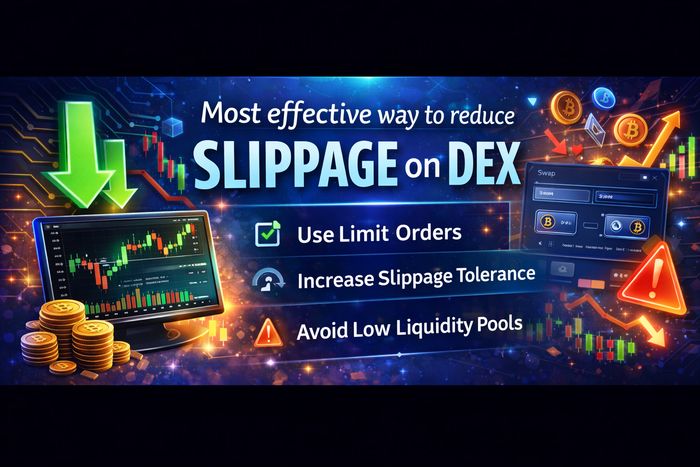
Most Effective Way to Reduce Slippage on a DEX
Slippage is one of the biggest hidden costs in decentralized trading. It can quietly turn a “good price” into a bad fill—especially on low-liquidity tokens, volatile markets, or congested networks. The good news: you can reduce slippage dramatically by choosing the right pool, optimizing order size and timing, using limit orders and aggregators, and protecting yourself from MEV and front-running. This guide breaks it down step-by-step in a practical, trader-friendly way.
Disclaimer: Educational content only. Not financial advice. DEX trading involves smart contract, liquidity, and market risks.
What slippage is (and why it’s worse on DEXs)
Slippage is the difference between the price you expect when you submit a swap and the price you actually receive when it executes. On centralized exchanges (CEXs), deep order books often reduce slippage for major pairs. On DEXs, many swaps use automated market makers (AMMs), where price is determined by a pool’s liquidity curve. This makes slippage highly sensitive to:
- Liquidity depth: smaller pools = bigger price impact.
- Trade size: larger swaps move price more.
- Volatility + congestion: price can change between quote and execution.
- MEV / front-running: bots can worsen your fill if your transaction is predictable.
Bottom line: slippage is not just a setting—it’s the result of market structure, liquidity, and transaction mechanics.
Main causes of slippage on DEXs
1) Price impact from shallow liquidity
In AMMs, the pool’s liquidity curve means that larger trades push the price further along the curve. If the pool is thin, your trade becomes a bigger percentage of the pool, creating higher price impact (slippage).
2) Volatility during execution
Even with a deep pool, fast-moving markets can shift price between the moment you sign the transaction and the moment it confirms. This is “market movement slippage.”
3) MEV (front-running and sandwich attacks)
On many chains, transactions sit in a public mempool before being included in a block. Bots can detect swaps with generous slippage tolerance and “sandwich” them: buy before you, sell after you, and capture the difference.
4) Wrong route (bad path selection)
Some swaps are expensive because the route is inefficient (e.g., direct pool is thin, while a multi-hop route through a more liquid asset would be cheaper). Aggregators and smart routing can reduce this.
Most effective ways to reduce DEX slippage
If you want the biggest impact with the least complexity, follow these steps in order. Each one can reduce slippage significantly.
1) Trade in the most liquid pool (this is the #1 lever)
Before swapping, check where liquidity is deepest for the pair. Deeper pools reduce price impact. If you have multiple pool options (different fees, different DEXs, different stable pairs), choose the route with the best depth and pricing.
- Tip: For many assets, going through a major intermediary (like a large stablecoin) can reduce slippage vs. a thin direct pool.
- Watch out: high APY pools can still be thin; yield incentives don’t always mean deep liquidity.
2) Reduce trade size or split large orders
Large swaps create the most slippage. If your order is big relative to pool depth, splitting it into smaller chunks can reduce price impact— especially if the market is active and liquidity replenishes between chunks.
- Practical approach: split into 2–5 parts, evaluate fills, and stop if slippage starts worsening.
- Trade-off: more transactions means more fees; only split if slippage savings exceed extra fees.
3) Use limit orders (when available) instead of market swaps
If your DEX or trading interface supports limit orders, you can avoid paying unexpected slippage. A limit order won’t execute unless your price is met, which protects you during sudden moves and can reduce MEV exposure in some cases.
4) Use an aggregator / smart routing (often a free win)
Smart routing can find better paths across multiple pools and venues, reducing price impact. This matters most for:
- Tokens with fragmented liquidity across pools
- Large trades
- Pairs with poor direct pool depth
5) Avoid volatile moments (timing reduces “movement slippage”)
Slippage spikes during major news, rapid breakouts, or heavy liquidation cascades. If you’re not trading urgently, consider:
- Trading during calmer market conditions
- Avoiding the seconds/minutes around major economic releases or big ecosystem announcements
- Waiting for spreads and volatility to normalize after a large candle
6) Pick the right fee tier / pool type (AMM structure matters)
Some AMMs offer different fee tiers (and sometimes different liquidity concentration). In concentrated liquidity environments, price impact can vary significantly depending on where liquidity is positioned. If the current price is outside the deepest liquidity range, slippage can worsen fast.
7) Don’t set slippage tolerance unnecessarily high
High slippage tolerance can invite MEV bots and turn a small price impact into a bad execution. Your slippage tolerance should be the minimum necessary for the trade to execute reliably.

Slippage tolerance settings: smart defaults
Slippage tolerance is the maximum price movement you accept before the swap reverts. Too low and your transaction fails; too high and you risk a poor fill. Here are practical starting points (adjust for volatility and liquidity):
Typical slippage tolerance ranges
- Highly liquid majors (e.g., large caps): ~0.1% to 0.5%
- Mid-liquidity tokens: ~0.5% to 1.0%
- Low-liquidity / microcaps: 1.0%+ (but be extremely cautious—this is where MEV risk rises)
When your slippage tolerance should be tighter
- You’re trading a large amount and want to reduce MEV/sandwich risk.
- The market is calm and liquidity is deep.
- You can use limit orders or you’re not in a hurry.
When it might need to be higher
- The token is thinly traded and the transaction keeps reverting (still a warning sign).
- Network congestion is causing long confirmation times (market can move before execution).
- You accept that higher slippage is the cost of urgency (but consider splitting/limit orders instead).
MEV, sandwich attacks & how to reduce front-running
MEV (Maximal Extractable Value) is a major slippage amplifier on public blockchains. Here are practical defenses:
1) Keep slippage tolerance low
This is one of the simplest anti-sandwich moves. If the bot can’t profit within your tolerance, it often won’t target you.
2) Prefer limit orders where possible
Limit orders can reduce surprise execution. They won’t fill at a worse price than you specify.
3) Trade smaller size / split orders
Big swaps are bigger targets. Breaking size reduces profitability for MEV bots and lowers pool price impact.
4) Avoid “obvious” mempool timing
During spikes and congested periods, MEV competition intensifies. Waiting for calmer network conditions can reduce MEV-related slippage.
5) Use trusted interfaces and double-check routes
Some interfaces provide better routing or optional protections. Even then, your best defense is still smart sizing, pool selection, and tight tolerance.

Quick checklist (copy & use): reduce slippage on DEX
- Choose the deepest liquidity pool/route for the pair.
- Split large orders if price impact is high (and fees allow).
- Use limit orders when available instead of market swaps.
- Use an aggregator or smart routing to find better paths.
- Avoid peak volatility and congested moments when possible.
- Set tight slippage tolerance (minimum needed to execute).
- Be cautious with thin tokens that require high slippage—higher manipulation/MEV risk.
- Review the quote: expected price impact + minimum received before confirming.
Want to avoid DEX slippage on big trades?
For larger size, many traders compare DEX execution versus order-book execution and choose the route with the lowest total cost (fees + slippage). If you want a place to explore spot markets and execution tools alongside your DEX activity, you can start here:
Create an account on BYBITTip: Execution quality is profit—optimize liquidity, sizing, and slippage tolerance.
FAQ: Most Effective Way to Reduce Slippage on DEX
What is the most effective way to reduce slippage on a DEX?
The most effective way is to trade in the deepest liquidity pool and keep your trade size small relative to pool depth. Combine this with a tight slippage tolerance, smart routing/aggregators, and limit orders when available.
Does increasing slippage tolerance reduce slippage?
No—raising slippage tolerance doesn’t reduce slippage. It only increases the maximum slippage you’re willing to accept. Higher tolerance can lead to worse fills and may increase MEV/sandwich risk.
Why does my swap fail when slippage tolerance is low?
The price may be moving quickly, liquidity may be thin, or your transaction may be confirming slowly due to congestion. Consider splitting the order, using a more liquid route, or using limit orders if possible.
How do I avoid sandwich attacks?
Keep slippage tolerance low, avoid large swaps, split orders, and prefer limit orders when available. Avoid trading during extreme congestion and volatility when MEV activity intensifies.
Is slippage worse on low-cap tokens?
Typically yes. Low-cap tokens often have thinner liquidity and higher manipulation risk, which increases price impact and slippage. If a token requires very high slippage tolerance, treat it as a liquidity and risk warning.
Should I use a DEX aggregator?
Often yes. Aggregators can route across multiple pools to reduce price impact, especially for fragmented liquidity or larger trades. Always verify the route and the minimum received before confirming.