Order Block Strategy in Crypto: A Practical, Step-by-Step Guide
Order Blocks (OBs) are institutional footprints left by large orders. They highlight price zones where “smart money” previously accumulated or distributed positions. This guide shows you exactly how to identify OBs, build objective rules, and test them before risking real capital.
What Is an Order Block?
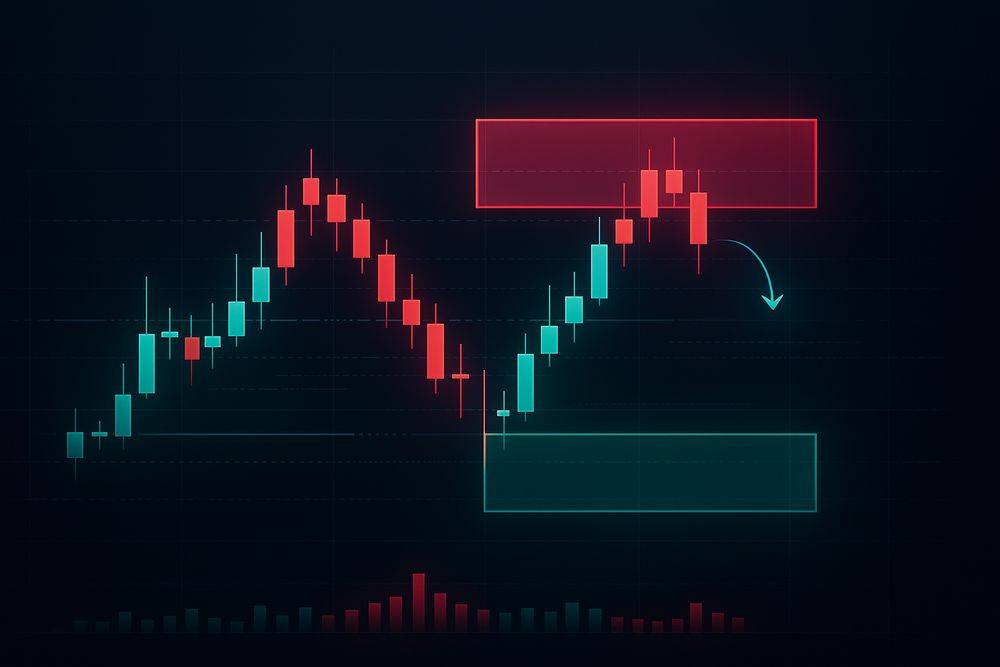
An Order Block is the last opposing candle (or small cluster) before a strong impulsive move that breaks market structure. It marks a price zone where large players likely executed significant orders. Price often revisits this zone later for “mitigation,” offering entries with defined risk.
- Bullish OB: last down candle before an impulsive rally that breaks a prior high.
- Bearish OB: last up candle before an impulsive selloff that breaks a prior low.
How to Identify Valid Order Blocks
- Find a structure break (BOS): price must take out a meaningful swing high (for bullish) or swing low (for bearish).
- Locate the origin candle(s): the final opposing candle(s) immediately before the impulsive move.
- Mark the zone: use the candle body or wick extremes; be consistent in your definition.
- Look for displacement: long candles, gaps, or swift movement away from the zone (shows aggressive order flow).
- Wait for a return: price revisits the zone to “mitigate” resting orders; seek confirmation to enter.
Types of Order Blocks
Bullish & Bearish Order Blocks
Standard OBs mark demand (bullish) or supply (bearish) zones. Entries are taken on a return to the zone with confirmation.
Breaker Blocks
A Breaker forms when a previous OB fails and price closes beyond it, turning the zone into a level of opposite polarity (support ↔ resistance). Traders look to fade retests in the new direction.
Mitigation Blocks
When price returns to an OB, fills unexecuted orders (“mitigates”), and resumes the impulsive direction. These retests often provide controlled-risk entries.
Objective Entry & Exit Rules
A) Baseline OB Retest Strategy
- Context: clear BOS with displacement away from the OB.
- Entry: on return to the OB, require a trigger (e.g., bullish/bearish engulfing, strong close back out of the zone, or LTF market structure shift).
- Stop: beyond the OB’s far boundary or swing extreme.
- Targets: first target at recent swing, then measured move or liquidity pools beyond highs/lows.
B) Breaker Block Continuation
- Setup: prior OB fails; price closes through and flips the zone.
- Entry: fade the first clean retest of the flipped zone in the new direction.
- Invalidation: decisive close back inside the broken zone.
C) OB + Trend Filter (200 EMA/SMA)
- Trade long OBs only when price > 200 EMA/SMA; short OBs only when price < 200 EMA/SMA.
- Improves selectivity in choppy conditions.
Confluence: Liquidity, FVG, Structure
- Liquidity sweeps: entries are stronger when the return to an OB first sweeps local highs/lows (stop hunt) and then rejects.
- FVG (Fair Value Gap): displacement often leaves an inefficiency. Refill of the FVG into an OB gives a high-confluence zone.
- Market structure: prefer OBs aligning with HH/HL (uptrend) or LH/LL (downtrend).
- Volume/Footprint (optional): absorption or delta shift at the OB strengthens conviction.
Timeframes & Multi-TF Alignment
- HTF bias (4h/1D): define the main trend and key HTF OBs.
- LTF execution (5m–15m/1h): wait for price to tap the HTF zone and confirm on LTF with a structure shift or reversal candle.
- Scalps vs swings: LTF gives more signals but demands tighter execution and fee control; HTF is slower but cleaner.
Risk Management & Trade Math
- Position sizing: risk a small fixed fraction (e.g., 0.5–2%) per trade.
- Stops: beyond the OB’s invalidation (far boundary or swing extreme).
- Targets: partial at nearest structure/liquidity; runners toward measured move or next liquidity pool.
- Costs: model fees, funding, and slippage—crucial for low-TF trading.
- Correlation: cap portfolio heat across highly correlated coins.
Validate fee impact, TP/SL and ROI per trade here: Free Crypto Profit Calculator.
Backtesting & Optimization
Keep your rules objective: define exactly what qualifies as an OB, what confirms entry, and how stops/targets are set. Test across bull, bear, and choppy regimes with realistic frictions. Maintain a clean out-of-sample set; consider walk-forward validation.
Illustrative Rule Set (Example)
- Bias: use 4h OBs to set direction; execute on 15m.
- Entry: price taps 4h bullish OB, sweeps a local LTF low, prints bullish engulfing; enter on candle close.
- Stop: below OB low or LTF swing.
- Targets: prior HTF high (partial), then beyond liquidity; optional trailing stop.
Only scale size if live stats (win rate, average R, drawdown) resemble your backtest signature.
Common Pitfalls & Pro Tips
- Subjectivity: inconsistent OB definitions lead to cherry-picking. Write rules and stick to them.
- Ignoring context: fading strong trends with counter-OBs is lower probability.
- No confirmation: catching the first touch without a trigger increases false starts.
- Costs: frequent entries/exits degrade edge—especially on low timeframes.
- Overfitting: if a rule only “works” on one coin or month, it’s likely curve-fit.
Ready to trade Order Blocks—carefully?
Open accounts with top exchanges and start small after a solid paper-trade period:
Check your fees and TP/SL math here: Free Crypto Profit Calculator.
FAQ: Order Block Strategy in Crypto
How do I define an Order Block objectively?
Use the last opposing candle before an impulsive move that breaks a prior swing (BOS). Mark the candle’s range as the OB zone and apply the same definition across all charts.
What’s the difference between an OB and a supply/demand zone?
Supply/demand zones are broader areas of imbalance; an OB is a more specific footprint tied to a structure break and displacement.
Which timeframe is best for OB trading?
No single best. Use higher timeframes (4h/1D) for bias and levels; execute on lower timeframes (5m–15m/1h) for precision.
Where should I place my stop?
Beyond the OB’s invalidation point (far boundary or swing extreme). Consider ATR-based buffers to reduce premature stop-outs.
What are Breaker and Mitigation blocks?
A Breaker is a failed OB that flips polarity after price closes through it; a Mitigation is the return to an OB to fill resting orders before continuation.