Updated: September 12, 2025
EMA Ribbon Crypto: The Trend-Following Overlay That Traders Actually Use
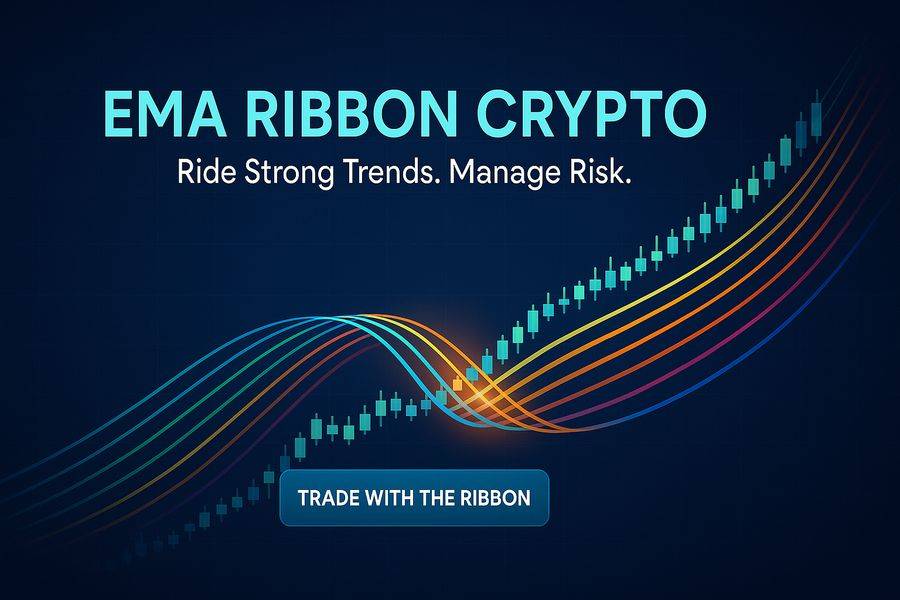
The EMA Ribbon is a bundle of exponential moving averages plotted together to visualize trend direction, momentum, and potential support/resistance zones. Instead of relying on a single moving average, the ribbon condenses multiple time horizons into one overlay, helping you judge trend strength, pullbacks, and reversals at a glance. In this guide, you’ll learn the optimal settings, how to read the signals, practical entry/exit rules, risk controls, and the exact steps to backtest before executing on BYBIT, BITGET, and MEXC.
What Is the EMA Ribbon?
The EMA Ribbon is a set of EMAs (e.g., 8/13/21/34/55/89) layered on the same chart and often color-coded from fastest to slowest. Because the EMA weights recent data more, the ribbon responds quickly to momentum while the slower EMAs anchor the bigger trend. Traders use the ribbon slope, spacing, and stacking order to decide whether to ride, fade, or stand aside.
EMAs are calculated with the smoothing factor α = 2/(n+1). Shorter lengths (like 8) react faster; longer lengths (like 89/200) smooth noise and define regime.
Why Use a Ribbon Instead of a Single EMA?
- Context at a glance: You see the micro, meso, and macro trend together.
- Dynamic pullback zones: Price often reacts inside the band during healthy trends.
- Strength vs. chop: Tight, parallel, rising bands → strong trend. Twisting, flat bands → range/chop.
- Adaptive stops: Trailing along the ribbon reduces guesswork.
Recommended EMA Ribbon Settings
| Style | Lengths | Use Case |
|---|---|---|
| Classic Fibonacci | 8, 13, 21, 34, 55, 89 | Balanced reactivity; great for 1h–4h–1D on BTC/ETH |
| Intraday Fast | 5, 8, 12, 20, 30 | Scalping/session trading; more signals, more whipsaws |
| Swing/Position | 20, 30, 50, 100, 200 | Smoother for 4h–1D–1W; clearer regime filter |
Color your ribbon from fast (warm/bright) to slow (cool/dim) so the stacking order is obvious at a glance.
How to Read Signals (Bullish/Bearish)
- Bullish stack: Fast EMAs above slow EMAs, all rising and well spaced. Dips into the band often find buyers.
- Bearish stack: Fast EMAs below slow EMAs, all falling and fanning out. Rallies into the band often fade.
- Flip: Ribbon compresses and inverts (fast lines cross through the slow group) → potential trend change.
- Compression: EMAs bunch and flatten → low-volatility coil; watch for breakout with volume.
Entries, Exits & Trailing Stops
Trend-Continuation Play
- Entry: Price pulls back into the upper third of a bullish ribbon and prints a strong continuation candle.
- Stop: Below the slowest EMA in the group or below a recent swing low.
- Take Profit: Partial at recent highs; trail the rest using the 20/30 EMA or the mid-band.
Trend-Reversal Play
- Trigger: Full ribbon flip (fast crosses through slow) + structure break (higher high/ lower low).
- Confirmation: Retest of the band from the new side with follow-through.
- Management: Tight initial stop beyond the far side of the band; trail with the fast EMA.
Filters That Sharpen the Ribbon
- Regime filter: Trade long only if price is above a rising 200 EMA; short only if below a falling 200 EMA.
- Volatility gate: Require ATR above a rolling median to avoid dead ranges.
- Time filter: Trade during high-liquidity overlaps (EU↔US, US↔Asia) for majors.
- Structure: Prefer entries that align with higher-timeframe swing structure.
Risk Management & Position Sizing
| Control | Practical Setup | Why It Matters |
|---|---|---|
| Per-trade risk | 0.5–1.5% of equity; scale with ATR | Survives losing streaks |
| Daily loss cap | Pause after −3R or −3 losers | Protects discipline |
| Slippage control | Limit/TWAP for thin pairs; avoid chasing breakouts in illiquid alts | Implicit costs add up |
| Diversification | Mix pairs/timeframes; cap correlated exposure | Smoother equity curve |
Timeframes & Which Markets Work Best
The EMA Ribbon shines in trending markets. BTC/ETH on 1h–4h–1D are staples. For altcoins, consider 4h–1D to reduce noise. Very low timeframes (1–5m) can work during peak liquidity but expect more whipsaws and higher fee sensitivity.
Backtesting the EMA Ribbon (Checklist)
- Define your ribbon set, entry/exit rules, stop/target logic, and risk model.
- Split data into in-sample (design) and out-of-sample (validation).
- Model costs: maker/taker fees, funding (perps), and realistic slippage by pair.
- Key metrics: CAGR, max drawdown, Sharpe/Sortino, hit rate, avg R, exposure time, trade frequency.
- Sensitivity: test nearby ribbon lengths; robust systems shouldn’t break if you nudge parameters.
- Walk-forward: re-validate quarterly; avoid curve-fitting.
- Pilot live with tiny size for 2–4 weeks before scaling.
Execution on BYBIT, BITGET, MEXC
Once your rules are validated, choose a venue based on liquidity, pairs, and tooling:
| Platform | Why Traders Use It | Ribbon Tips | Start |
|---|---|---|---|
| BYBIT | Deep perp liquidity, advanced order types | Trail along 20/30 EMA; use Post-Only for maker rebates; set TP/SL on entry | Trade on BYBIT |
| BITGET | Strategy trading & copy-trading tools | Automate continuation/reversal playbooks; test 8–13–21 vs 20–30–50 stacks | Start on BITGET |
| MEXC | Broad alt listings for momentum rotations | Prefer slower stacks (20–30–50–100–200) on 4h/1D to reduce whipsaws | Explore MEXC |
FAQ
What EMA lengths should I use in the ribbon?
For a balanced setup, try 8/13/21/34/55/89. For swing trading, slow it down (20/30/50/100/200). Adjust by timeframe and pair liquidity.
How do I know the trend is strong?
Look for a clean bullish/bearish stacking order, parallel lines, and consistent spacing. Compression and twists hint at range or transition.
Can I use the ribbon for entries and stops?
Yes. Enter on pullbacks into a trending band with confirmation, and trail below/above the slow side of the ribbon or a chosen EMA (20/30/50).
Does the EMA Ribbon work on altcoins?
It can, but thin alts whipsaw more. Use slower stacks on higher timeframes and manage slippage carefully.
EMA Ribbon vs. SMA Ribbon?
EMAs react faster to crypto’s momentum; SMAs are smoother but slower. Many traders prefer EMAs for timing and SMAs for higher-timeframe context.
Glossary
- EMA: Exponential Moving Average, weights recent price more heavily.
- Ribbon: A group of EMAs plotted together to show trend structure.
- Stacking order: Relative position of fast vs slow EMAs (bullish or bearish).
- ATR: Average True Range, a volatility measure for stops and filters.
- R-multiple: Profit/loss measured relative to initial risk.
Disclaimer: This article is educational and not financial advice. Crypto and derivatives involve risk; only trade what you can afford to lose.