Updated: September 12, 2025
EMA Crossover Crypto: A Complete, Practical Guide for 2025
The EMA crossover is a classic, rules-based trend strategy where a fast exponential moving average (EMA) crosses a slow EMA to signal entries and exits. In crypto’s 24/7 markets, EMAs react faster than SMAs and can help you participate in strong trends while limiting time spent in chop. This guide covers the math, common settings, strategy rules, risk controls, and a step-by-step process to backtest and execute on leading venues like BYBIT, BITGET, and MEXC.

What Is an EMA? (Formula & Intuition)
The Exponential Moving Average (EMA) weights recent prices more heavily than older prices, making it more responsive in fast markets.
● Recurrence: EMAt = α × Pricet + (1 − α) × EMAt−1
● Seed: EMA0 often starts as the SMA of the first n observations.
Intuition: the EMA is like a “spring-loaded” average—recent candles pull harder. Shorter EMAs (e.g., 9) react faster; longer EMAs (e.g., 50/200) smooth noise.
EMA Crossover Types & Popular Settings
| Pairing | Nickname/Use | Behavior |
|---|---|---|
| 9/21 | Short-term swing/intraday | Fast, catches early moves; more false signals in chop |
| 12/26 | MACD-style core | Balanced reactivity; popular across markets |
| 20/50 | Medium-term trend | Smoother; fewer trades; better on higher TFs |
| 50/200 | “Golden/Death Cross” trend regime | Very slow; best for multi-week cycles |
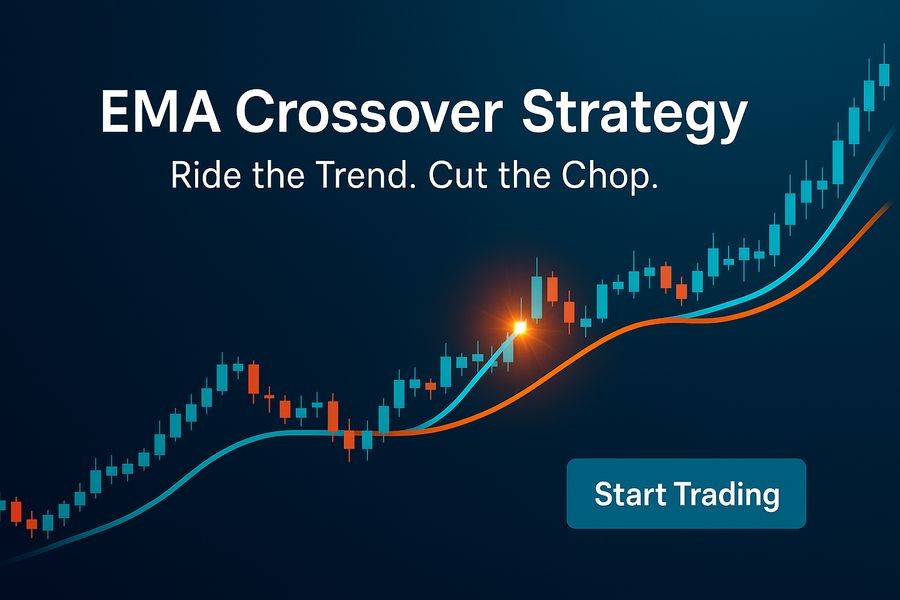
A bullish crossover occurs when the fast EMA closes above the slow EMA; a bearish crossover is the opposite. Some traders also monitor triple-EMA stacks (e.g., 20/50/200) to confirm trend regime.
Clear Entry/Exit Rules (Spot & Derivatives)
Simple Long-Only Rules (Spot)
- Entry: Fast EMA crosses above slow EMA and candle closes. Optional filter: price above the 200 EMA.
- Exit: Fast EMA crosses below slow EMA or price hits stop-loss.
- Stop: Use ATR-based (e.g., 2× ATR) or a swing-low below structure.
- Take Profit: Fixed R-multiple (e.g., 2R) or trailing stop via 20 EMA or chandelier exit.
Long/Short Rules (Perpetual Futures)
- Long: Fast > Slow, higher-timeframe bias bullish; enter on retest of the EMAs.
- Short: Fast < Slow, bias bearish; avoid shorts during extreme funding squeezes.
- Risk: Cap leverage; predefine max daily loss and max concurrent positions.
Derivatives carry liquidation risk. Start with small size and hard stops. Funding and fees can erode edge for high-frequency crossover systems.
Filters That Improve Signal Quality
- HTF Trend: Trade only long when daily 200 EMA slope is up; only short when it’s down.
- Volatility Gate: Require ATR > rolling median ATR to avoid dead markets.
- Structure: Prefer crossovers that occur above a recent swing-high (breakout) or after a pullback to the slow EMA.
- Time Filter: For intraday, avoid low-liquidity hours; trade during overlapping sessions.
Risk Management for EMA Strategies
| Control | How to Apply | Why It Matters |
|---|---|---|
| Position sizing | Risk 0.5–1.5% of equity per trade; scale with volatility | Prevents strings of losses from compounding |
| Drawdown guard | Daily/weekly loss limits; pause after X consecutive losses | Protects mental capital and account health |
| Slippage control | Use limit/TWAP in thin pairs; avoid news spikes | Implicit costs can kill trend edges |
| Diversification | Trade uncorrelated pairs/timeframes | Smooths the equity curve |

Best Timeframes & Markets
Crossovers work best in trending markets with decent liquidity. On majors (BTC, ETH), 1h–4h–1D are popular. On alts, consider 4h–1D to reduce noise. For scalping, 5–15m can work during high-liquidity sessions but expect more whipsaws.
How to Backtest an EMA Crossover (Checklist)
- Define: Choose pairs, timeframe, EMA lengths, entry/exit rules, and risk parameters.
- Sample split: In-sample (develop) vs. out-of-sample (validate). Avoid peeking.
- Metrics: CAGR, max drawdown, Sharpe/Sortino, win rate, avg R, trade frequency, slippage/fees assumptions.
- Sensitivity: Test nearby settings (e.g., 8/21, 10/24, 14/28). Robust systems aren’t overly parameter-sensitive.
- Walk-forward: Refit infrequently (e.g., quarterly) and validate on new data.
- Live pilot: Paper trade or tiny size for 2–4 weeks before scaling.
Execution on BYBIT, BITGET, MEXC
Once you have rules and risk settings, you can execute manually or automate. The three platforms below are popular with EMA traders:
| Platform | Why Traders Use It | EMA Tips | Start |
|---|---|---|---|
| BYBIT | Deep perp liquidity on majors; advanced order types | Use Post-Only for maker rebates; set TP/SL on entry | Trade on BYBIT |
| BITGET | Copy-trading ecosystem; strategy trading tools | Test 9/21 on 1h and 4h; explore grid/TA bots for automation | Try BITGET |
| MEXC | Broad alt listings for momentum rotations | Prefer 20/50 on 4h/1D to reduce whipsaws in thin alts | Explore MEXC |
Common Mistakes & How to Avoid Them
- Over-optimization: Curve-fitting EMA lengths to the past. Solution: use ranges and walk-forward testing.
- Ignoring costs: Fees, funding, and slippage can erase edge—model them realistically.
- Trading every cross: Use filters (trend/ATR/session) to avoid chop.
- No hard stops: Trend strategies need defined invalidation to survive regime shifts.
- Poor diversification: Spread risk across pairs and timeframes; cap correlated exposure.
FAQ
What is the best EMA crossover for crypto?
There is no universal best. 9/21 is popular for faster signals; 12/26 is balanced; 20/50 and 50/200 are slower but cleaner. Test on your pairs/timeframe with realistic costs.
Are EMA crossovers profitable?
They can be in trending regimes and with disciplined risk control. Profitability depends on markets traded, costs, filters, and execution quality.
Which timeframe should I use?
For majors, 1h–4h–1D are common. Lower timeframes require tighter risk and often deliver more whipsaws.
Can I automate the strategy?
Yes—most platforms and third-party tools support EMA signals. Start with paper trading or tiny size, then scale cautiously.
EMA vs SMA for crossovers?
EMAs react faster to new information, which is useful in crypto. SMAs are smoother but slower; try both in backtests.

Glossary
- EMA: Exponential moving average, weights recent prices more.
- Crossover: Fast EMA crossing slow EMA, signaling trend change.
- ATR: Average True Range, a volatility measure used for stops/filters.
- R-Multiple: Profit or loss measured relative to initial risk per trade.
- Walk-Forward: Re-validating a strategy on unseen data over time.
Disclaimer: Nothing here is financial advice. Crypto and derivatives carry risk; trade only what you can afford to lose.