Updated: September 12, 2025
Crypto EMA Cross Alert: How to Build, Test, and Automate a Reliable Crossover System
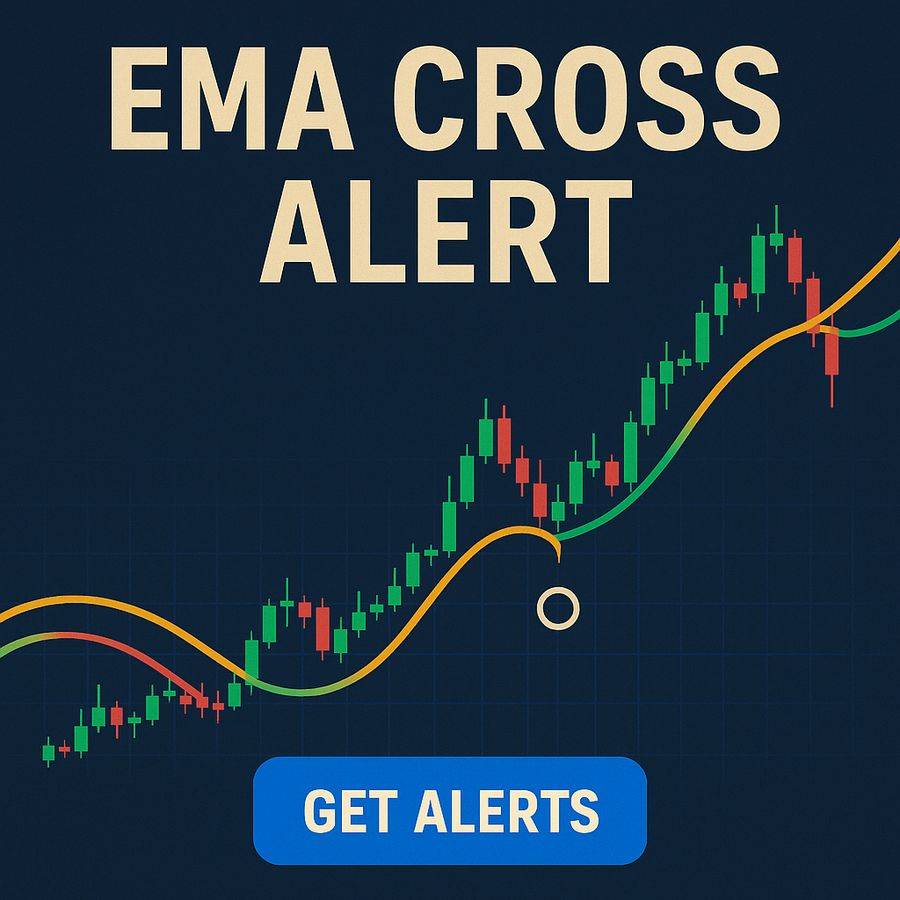
A Crypto EMA cross alert notifies you the moment a fast Exponential Moving Average crosses a slow EMA—a classic, rules-based way to detect potential trend shifts in 24/7 markets. This guide walks through the indicator logic, the most common settings (9/21, 12/26, 20/50), how to create alerts, route them to Telegram/email/webhooks, and how to execute with discipline on BYBIT, BITGET, and MEXC.
What Is an EMA Cross Alert?
An EMA cross alert triggers when a faster EMA (e.g., 9) crosses a slower EMA (e.g., 21). A bullish cross (fast above slow) can signal a potential uptrend; a bearish cross suggests the opposite. Alerts help you act consistently, even when you’re away from charts, by pinging your phone, email, or bot.
Best EMA Pairs & When to Use Them
| Pair | Strength | Behavior | When to Use |
|---|---|---|---|
| 9/21 | Fast | Catches early momentum, more signals & whipsaws | Intraday to 4h; news/volatility traders |
| 12/26 | Balanced | Classic MACD-style core | 1h–4h–1D on majors |
| 20/50 | Slower | Smoother, fewer trades | 4h–1D, swing trades & trend riders |
| 50/200 | Very slow | Regime “golden/death cross” | 1D–1W cyclical bias |
Signal Logic (Confirmed vs. Intrabar)
- Confirmed close: Alert only when the bar closes with fast EMA above/below slow EMA. Fewer false signals.
- Intrabar cross: Fires as soon as lines touch/cross during the candle. Faster but noisier; better for scalpers.
Build the Alert: Step-by-Step
- Choose your pair/timeframe and EMA lengths (e.g., 12/26 on 1h).
- Add two EMAs to your chart and confirm the math (exponential, not simple).
- Decide confirmed close vs intrabar behavior.
- Create two alert conditions: Bullish Cross and Bearish Cross.
- Set Once per bar close for confirmed, or Once per bar for intrabar.
- Configure notifications: app push, email, webhook, or Telegram bot (see below).
- Paper trade for a week; measure signal quality, then connect to your execution workflow.
Pine Script: Ready-to-Use EMA Cross Alert
Add the script to your chart, click the alert icon, and select either “Bullish EMA Cross” or “Bearish EMA Cross”. Keep alert messages concise and machine-readable if you plan to parse them downstream.
Routing Alerts: Telegram, Email, Webhook
Telegram
- Create a bot via @BotFather and get the bot token.
- Get your chat ID by messaging the bot and checking updates, or use a helper bot.
- Use a relay service or your own endpoint to forward alert text to the bot’s sendMessage method.
Turn on email notifications. Keep subjects like “BTCUSDT 12/26 Bull Cross (1H)” for searchability.
Webhook
Point the alert to a secure HTTPS endpoint. Parse the payload, authenticate (HMAC/Bearer), and forward to your execution logic or risk dashboard.
Security tip: Never hit exchange keys directly from public webhooks. Use a private middleware with rate limits, IP allowlists, and signature checks.
Filters to Reduce Whipsaws
- Trend filter: Only take longs when price is above a rising 200 EMA; shorts when below a falling 200 EMA.
- ATR gate: Require ATR > median ATR for the last N bars to avoid dead ranges.
- Structure: For longs, prefer crosses that occur above a recent swing high or after a pullback.
- Session timing: Trigger alerts during high-liquidity overlaps for majors; be cautious around low-volume hours.
Risk Management & Playbooks
| Rule | Setup | Why |
|---|---|---|
| Per-trade risk | 0.5–1.5% of equity; size by ATR | Survive losing streaks |
| Stops | Swing low/high or 1.5–2.5× ATR | Defines invalidation |
| Daily cap | Pause after −3R or −3 losers | Protects discipline |
| Slippage control | Use limit/TWAP for thin pairs | Keeps implicit costs in check |
| Diversification | Mix pairs/timeframes; cap correlation | Smoother equity curve |
Backtesting the Strategy (Checklist)
- Define: Pairs, timeframe, EMA lengths, entry/exit, filters, risk.
- Split: In-sample (design) vs out-of-sample (validation).
- Model costs: Maker/taker fees, funding (perps), and slippage per pair.
- Metrics: CAGR, max DD, Sharpe/Sortino, win rate, avg R, exposure, trade count.
- Sensitivity: Try 8/21, 10/24, 14/28 near your chosen pair; robust systems aren’t brittle.
- Walk-forward: Re-test quarterly; avoid constant retuning.
- Pilot live: Paper or tiny size 2–4 weeks; only then scale.
Execution on BYBIT, BITGET, MEXC
Once your alerts fire, you can execute manually or via your own automation. Consider liquidity, order types, and fees:
| Platform | Why Traders Use It | Tips for EMA Cross |
|---|---|---|
| BYBIT | Deep perp liquidity; advanced order types | Set TP/SL with entry; use Post-Only to earn maker rebates in trends |
| BITGET | Strategy tools & copy-trading ecosystem | Automate 9/21 or 12/26 via bots; test 1h/4h filters |
| MEXC | Broad alt listings; frequent momentum | Favor 20/50 on 4h/1D for cleaner signals on thinner alts |
FAQ
Which EMA pair is best for alerts?
There’s no universal best. 9/21 is fast; 12/26 is balanced; 20/50 is slower and cleaner. Choose based on timeframe, volatility, and your tolerance for whipsaws.
Should I trigger on bar close or intrabar?
Bar close reduces noise and false signals. Intrabar is faster but riskier. Many traders start with close-confirmed and later test intrabar.
Can I route alerts to Telegram?
Yes—use a bot token and a relay or your own webhook to forward messages to your chat ID.
How do I avoid overtrading EMA crosses?
Add filters (200 EMA regime, ATR gate, session timing) and define risk rules (max daily loss, per-trade risk).
Are EMA cross alerts profitable?
They can be in trending regimes with disciplined filters and risk management. Always backtest with realistic fees and slippage.
Glossary
- EMA: Exponential Moving Average, weights recent prices more.
- Crossover: Fast EMA moves above/below slow EMA to signal potential trend change.
- ATR: Average True Range; a volatility measure used for gates and stops.
- Webhook: HTTP callback endpoint that receives alert payloads.
- TP/SL: Take-profit / Stop-loss orders used for risk management.
Disclaimer: This article is educational and not financial advice. Crypto and derivatives involve risk; only trade what you can afford to lose.