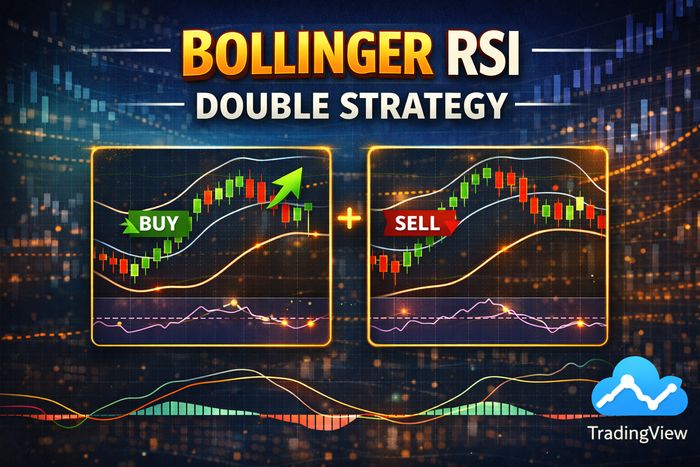
Bollinger RSI Double Strategy (Complete Two-Indicator Trading System)
A Bollinger Bands + RSI “double strategy” is popular because it combines two complementary perspectives: Bollinger Bands define volatility and price location, while RSI measures momentum condition and helps you avoid taking trades when price is stretched but momentum is still strong (or when RSI is “oversold” but the market is trending down hard).
Many traders struggle with Bollinger Bands because they treat every band touch as an automatic reversal. The Bollinger RSI double strategy fixes that by adding a clear filter: you only trade band touches when RSI confirms the right momentum behavior. In this guide you’ll learn the best settings, step-by-step rules for range and trend environments, high-probability entry triggers, stop-loss and take-profit logic, and practical tips for applying the strategy in crypto markets.
Educational content only. Trading involves risk.
What Is the Bollinger RSI Double Strategy?
The Bollinger RSI double strategy is a two-indicator system built around one simple idea: use Bollinger Bands to find price extremes, and use RSI to confirm whether the extreme is tradable. In practice, the strategy has two “modes”:
- Range mode (mean reversion): trade band touches back toward the middle band when RSI confirms exhaustion.
- Trend mode (continuation): trade pullbacks to the middle band when RSI confirms momentum is still healthy.
This is why it’s called a “double” strategy: Bollinger Bands provide the setup zone, and RSI provides the quality filter. With only two tools, it stays fast and readable—ideal for day trading and scalping—while still preventing many low-probability trades.

Why Bollinger Bands + RSI Work So Well Together
1) Bollinger Bands show volatility context
Bands expand when volatility increases and contract when volatility drops. That’s critical because mean reversion works best when volatility is stable and the market is ranging—not when it’s exploding into a trend.
2) RSI prevents “touch trading” mistakes
In a strong uptrend, price can keep hitting the upper band while RSI stays strong. If you short every upper-band touch, you’ll get run over. RSI helps you distinguish between: healthy trend strength (RSI holds strong) and exhaustion (RSI weakens or diverges).
3) The combo creates a fast yes/no checklist
Scalpers and day traders need decisions that are quick. Two indicators are enough: Bollinger Bands define where you should be looking, and RSI confirms whether the trade has a favorable probability.
Internal link idea for your site: If you have a dedicated article on settings, link it here: Bollinger Bands best settings.
Best Settings for the Bollinger RSI Double Strategy
Start with classic, stable parameters. You’ll get cleaner signals and avoid the trap of constant “optimization.” Then, if you trade extremely low timeframes or highly volatile crypto pairs, use the recommended adjustments below.
Baseline settings (recommended for most traders)
- Bollinger Bands: 20-period, 2 standard deviations (20,2)
- RSI: 14-period (levels: 30 / 50 / 70)
Timeframe presets (practical starting points)
| Style | Timeframe | Bands | RSI | Why |
|---|---|---|---|---|
| Day trading (balanced) | 5m–15m | 20,2 | 14 | Stable signals and easy execution |
| Scalping (faster) | 1m–3m | 10–14,2 | 7–14 | More responsive; needs strict filters |
| High-volatility crypto | Any | 20,2.2–2.5 | 14 | Reduces constant “touch noise” |
One important note about RSI levels
RSI 70/30 can be useful, but for this strategy the 50 level is often more important: it helps you decide whether momentum supports trend continuation (RSI holding above 50 in uptrends) or trend weakness (RSI failing below 50).

Core Rules: Environment → Signal → Execution
The fastest way to improve your Bollinger RSI performance is to stop asking “Is there a signal?” and start asking: What environment am I in? Your environment determines whether you should trade mean reversion or continuation.
Step 1: Identify the environment using Bollinger Bands
- Range environment: bands mostly flat; price rotates between bands; frequent returns to middle band.
- Trend environment: bands slope; price walks an outer band; pullbacks respect the middle band.
- Compression: bands squeeze tightly; breakout risk is high (avoid fading).
Step 2: Use RSI as a filter, not a trigger
- Range mean reversion: RSI should show exhaustion (turning, divergence, or failure to extend further).
- Trend continuation: RSI should hold “trend strength” (often above 50 in uptrends, below 50 in downtrends).
Step 3: Execute with a clear invalidation point
Every trade must have a logical stop (invalidation) and a logical first target. For mean reversion, the middle band is often the first target; for continuation, the outer band or a prior swing is common.
Setup A: Range Mean-Reversion (Band Touch + RSI Confirmation)
This is the classic “double strategy” setup. You are trading the snap-back from an outer band back toward the middle band. The key is that RSI must confirm exhaustion—otherwise you’re just guessing.
Long entry (lower band bounce)
- Bands: flat/neutral; no consistent band walk.
- Price: touches or slightly pierces the lower band.
- RSI filter: RSI turns up (optional: bullish divergence vs the prior low).
- Entry trigger: rejection candle (wick) or an engulfing candle from the band.
- Stop: below the rejection swing low.
- Target 1: middle band (take partial or full).
- Target 2: opposite band only if range structure remains intact.
Short entry (upper band fade)
- Bands: flat/neutral.
- Price: touches upper band and stalls.
- RSI filter: RSI turns down (optional: bearish divergence).
- Entry trigger: rejection or bearish engulfing candle.
- Stop: above the swing high.
- Target: middle band first.
When to skip this setup
Skip mean reversion if bands are strongly sloped or price is closing repeatedly at one outer band (band-walk). In those conditions, trend continuation has higher probability than fading.
Setup B: Trend Continuation (Middle Band Pullback + RSI Filter)
This is where many traders underuse Bollinger Bands. In trends, bands are not “overbought/oversold lines”— they’re a volatility roadmap. The middle band often acts as a pullback zone. RSI helps confirm whether the trend still has momentum.
Long entry (uptrend continuation)
- Bands: slope upward.
- Price: pulls back toward the middle band.
- RSI filter: RSI holds above ~50 or quickly reclaims 50 after dipping.
- Entry trigger: continuation candle off the middle band (or break of pullback micro-high).
- Stop: below pullback swing low (or a decisive close below middle band).
- Target: prior high then upper band extension.
Short entry (downtrend continuation)
- Bands: slope downward.
- Price: rallies toward the middle band.
- RSI filter: RSI stays below ~50 or fails at 50.
- Entry trigger: rejection + breakdown candle.
- Stop: above pullback swing high.
- Target: prior low then lower band extension.
Why this works: it keeps you trading with momentum instead of fading strength. RSI is the “trend health” check.
Bonus Filter: Squeezes, Breakouts, and When to Stop Fading Bands
A key advantage of Bollinger Bands is spotting volatility compression. When bands squeeze tightly, the probability of a breakout increases, and mean reversion scalps become less reliable because price can “escape” the range quickly.
Squeeze checklist
- Bands are much narrower than the last 20–50 candles.
- Price is compressing near the middle band.
- RSI often hovers near the 50 zone during compression.
Practical rule
If the market is clearly squeezing, reduce mean reversion trades and wait for either: (1) a breakout + continuation, or (2) a confirmed return into a stable range. This single filter can save you many low-quality trades.
Stops, Targets, and Position Sizing (Make It Consistent)
The Bollinger RSI double strategy becomes profitable only when risk rules are consistent. Two indicators can’t save you from oversized trades or random exits.
Stop-loss rules (simple)
- Mean reversion: stop beyond the rejection swing extreme (not just “a few ticks”).
- Trend continuation: stop beyond pullback swing or a close beyond the middle band.
Take-profit rules (practical)
- Range trades: middle band is the first target (often the best target).
- Trend trades: prior swing, then outer band extension.
- R-multiple approach: aim for 1.5–2R on clean continuation setups; take partials to reduce stress.
Position sizing
Size based on stop distance so your risk per trade stays consistent. If your stop must be wide, your position must be smaller—this is how you survive volatility spikes in crypto.
Daily guardrails
- Daily loss limit: stop trading if hit.
- Max trades/day: prevents overtrading.
- Rule-break stop: if you break your rules twice, pause for the session.
Common Mistakes (and How to Fix Them)
Mistake 1: Using RSI 70/30 as a mechanical reversal signal
RSI can stay overbought/oversold in trends. Fix: prioritize RSI’s behavior around the 50 level and use divergence only as a bonus, not as a requirement.
Mistake 2: Ignoring band slope
If bands are sloping hard and price is walking an outer band, mean reversion becomes low probability. Fix: switch to trend continuation pullbacks to the middle band.
Mistake 3: No structure
Indicators work best at structure points (range edges, swing highs/lows). Fix: only trade band touches that happen at meaningful locations, and always define invalidation clearly.
Mistake 4: Over-optimizing settings
Constant parameter tweaks create inconsistent signals and weak learning. Fix: keep 20,2 and RSI 14 as baseline and only change one variable at a time.
Crypto Workflow and Execution Tips (Bollinger RSI Strategy)
Many traders chart in TradingView and execute on a crypto exchange. The best approach is to keep your settings stable, trade liquid pairs, and focus on repeatable setups rather than constant experimentation.
Platforms many crypto traders consider
- BYBIT – often used for active trading workflows where fast execution and derivatives access matter.
- BITGET – commonly chosen for a straightforward interface and an active crypto ecosystem.
- MEXC – frequently used by traders looking for broad market selection and fast-moving opportunities.
Quick pre-trade checklist
- Environment: range, trend, or squeeze?
- Band location: outer band touch or middle band pullback?
- RSI filter: exhaustion (range) or strength around 50 (trend)?
- Stop/target: where is invalidation and first logical exit?
- Risk: position size fits the stop distance?
Disclosure: This article may contain affiliate links. If you use them, we may earn a commission at no extra cost to you.

FAQ: Bollinger RSI Double Strategy
What is the Bollinger RSI double strategy?
It’s a two-indicator system where Bollinger Bands identify volatility-based price extremes and RSI filters momentum to confirm whether the band touch or pullback is tradable. It’s commonly used for range mean reversion and trend continuation pullbacks.
What are the best settings for Bollinger Bands and RSI?
A strong baseline is Bollinger Bands 20,2 and RSI 14. Scalpers may test shorter band periods (10–14) for faster signals, while very volatile crypto pairs may benefit from slightly wider deviation (2.2–2.5).
Is this strategy better for range trading or trend trading?
It can work for both, but you must switch modes based on environment. Mean reversion works best in ranges with flat bands. Trend continuation works best when bands slope and RSI holds strength around the 50 level.
How do I avoid false reversals at the bands?
Don’t trade band touches alone. Require RSI confirmation (turning, divergence, or momentum behavior). Also avoid fading when price is “walking the band” and bands are strongly sloped.
Can I use the Bollinger RSI strategy for crypto?
Yes. It’s popular in crypto because Bollinger Bands adapt to volatility and RSI helps filter momentum. Use strict risk rules, trade liquid pairs, and avoid over-leveraging until you have consistent results.