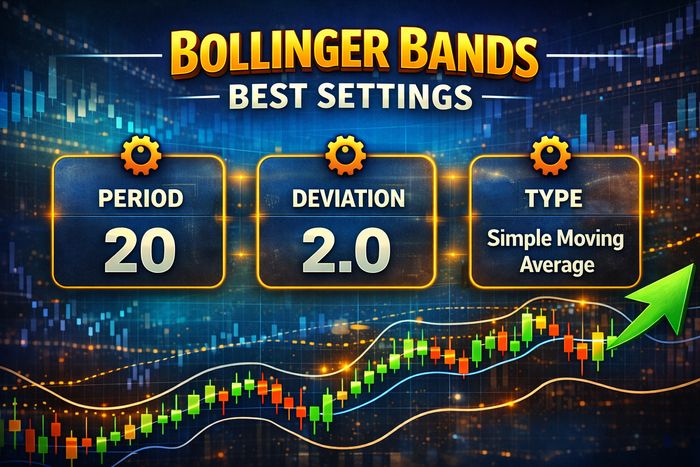
Bollinger Bands Best Settings: The Complete Practical Guide
“Bollinger Bands best settings” is one of the most searched questions in technical analysis—because traders want a setup that works across different markets, timeframes, and volatility regimes. The truth is: there is no single “magic” setting that wins everywhere. But there are best-practice presets that professional traders use as reliable starting points, plus a simple framework for adapting settings without curve-fitting.
In this guide you’ll learn the default settings (and why they work), the best presets for scalping, day trading, swing trading, and crypto, and how to choose the right parameters based on volatility and market behavior. You’ll also learn when not to change settings and how to avoid the most common optimization traps.
Educational content only. Trading involves risk.
What “Bollinger Bands Best Settings” Really Means
When traders ask for the best Bollinger Bands settings, they often expect a single “perfect” combination. But the “best” settings depend on how you trade and what the market is doing. Bollinger Bands measure volatility around a moving average. Changing the period or the standard deviation multiplier changes how sensitive the bands are.
Settings control three things
- Sensitivity: Shorter periods react faster but generate more noise and false signals.
- Width: Higher multipliers create wider bands, reducing band touches but potentially delaying signals.
- Trade style fit: Scalpers need quicker responsiveness; swing traders often prefer smoother bands.
The goal isn’t to force a universal parameter set. The goal is to choose a stable baseline, then adapt only when your timeframe, instrument volatility, or strategy requires it.

Default Bollinger Bands Settings (20,2) Explained
The classic default is 20-period with a 2 standard deviation multiplier—often written as 20,2. This became the standard because it balances responsiveness with stability across many markets.
Why 20,2 works so often
- 20 periods is long enough to smooth micro-noise but short enough to respond to changes in trend and volatility.
- 2 standard deviations captures a large portion of typical price movement without making bands too tight.
- It provides a consistent framework for mean reversion, breakout detection, and trend continuation.
When default settings may feel “wrong”
If you trade very low timeframes (like 1-minute scalps), the 20-period band can sometimes lag. If you trade very volatile instruments (certain altcoins, news spikes), a 2x multiplier can create too many “touches,” which can trick you into fading trends. In those cases, adjust thoughtfully—don’t guess.
Next, you’ll get practical presets that match common trading styles.
Best Bollinger Bands Settings by Timeframe (Proven Presets)
Use the presets below as a starting point. They’re designed to match typical noise levels and volatility behavior by timeframe. You can refine from there—but the baseline should stay stable long enough to build consistent execution.
| Timeframe | Best “Balanced” | Faster (more signals) | Smoother (fewer signals) | Use case |
|---|---|---|---|---|
| 1–3 minute | 20,2 | 10–14,2 | 30,2 | Scalping, quick mean reversion |
| 5 minute | 20,2 | 14–18,2 | 30,2 | Core intraday trading |
| 15 minute | 20,2 | 14–18,2 | 30–50,2 | Cleaner signals, trend context |
| 1 hour | 20,2 | 20,1.8 | 30,2 | Swing entries and volatility mapping |
| 4 hour / Daily | 20,2 | 20,1.8 | 50,2 | Swing trading, position context |
If you’re unsure, start with 20,2 on your execution timeframe and focus on mastering one strategy first. Consistency beats “perfect parameters.”
Best Settings by Market: Crypto vs Forex vs Stocks
Markets have different volatility “personalities.” Crypto tends to show sharper intraday swings and more frequent volatility regime changes, while major forex pairs can be smoother (outside key sessions or news), and stocks vary widely by ticker.
Crypto (BTC, ETH, majors)
- Baseline: 20,2 is still a strong default on 5m–1h.
- Highly volatile altcoins: consider keeping the period similar but widening the multiplier to 2.2–2.5 to reduce constant band “touch noise.”
- Breakout traders: band contraction matters more than exact parameters—use bandwidth/squeeze logic.
Forex (major pairs)
- Baseline: 20,2 works well on 15m–4h.
- Lower volatility periods: some traders test 20,1.8 to keep bands from becoming too wide and “inactive.”
Stocks / indices
- Baseline: 20,2 remains the standard.
- High-beta tickers: multiplier adjustments (2.2–2.5) can improve signal quality when price constantly pierces bands.
- Index products: often smoother; you may not need changes unless your strategy demands them.
The deeper point: in most cases, you don’t need to reinvent the wheel. Start with 20,2 and adjust one variable at a time when you have a clear reason.

How to Choose the Best Bollinger Bands Settings (Simple Framework)
Instead of guessing, use this framework. It works for scalping, day trading, and swing trading—and it keeps you from constantly changing indicators.
Step 1: Choose your strategy type
- Mean reversion: You want reliable “extension” signals and clean reversion to the middle band.
- Breakouts: You want to detect volatility compression and expansion early (squeezes).
- Trend continuation: You want bands that slope smoothly and don’t overreact to micro pullbacks.
Step 2: Match the band period to noise level
- More noise (1m–3m): Consider smoothing with 20–30 periods if signals are chaotic.
- Balanced (5m–15m): 20 periods is usually ideal.
- Higher timeframe (1h+): 20 remains strong; 30–50 can smooth swing context.
Step 3: Adjust the multiplier only when touches are “meaningless”
A practical rule: if price is hitting bands constantly and those touches don’t correspond to meaningful extensions, widen the multiplier slightly. If price rarely reaches the bands and your strategy needs extensions, narrow slightly. Make small changes (example: 2.0 → 2.2), not big jumps.
Step 4: Keep settings stable for long enough to learn
Many traders change settings after 5 losing trades. That’s not optimization—that’s emotional calibration. Use a consistent sample (dozens of trades) before making any parameter decision.
If you want, pair this guide with your own internal article: Default 20,2 explained and how to avoid overfitting.
Multiplier Guide: 1.5 vs 2 vs 2.5 (When to Use Each)
The standard deviation multiplier determines how “strict” an extension is. Here’s a practical way to think about it.
1.5–1.8: More signals, more noise
- Pros: Earlier band touches, more frequent mean-reversion opportunities.
- Cons: Higher false signal rate, easier to get chopped up in trends.
- Best for: Scalpers with tight execution rules and strong confirmations.
2.0: The best all-around default
- Pros: Balanced signal rate and reliability.
- Cons: Can feel “slow” on ultra-low timeframes if you need rapid entries.
- Best for: Most day traders and swing traders.
2.2–2.5: Fewer touches, cleaner extensions
- Pros: Reduces constant touching in volatile instruments; helps avoid fading strong trends.
- Cons: Less frequent opportunities; may delay entries.
- Best for: Highly volatile crypto pairs, news spikes, or traders who want higher-quality extremes.
A good compromise for volatile markets is keeping the period stable (like 20) and adjusting the multiplier slightly (2.0 → 2.2). That preserves the “language” of the bands while improving signal clarity.
How to Optimize Bollinger Bands Settings Without Overfitting
Overfitting happens when you tweak settings to match the past so perfectly that the setup fails in live markets. To keep your settings genuinely useful, use these rules.
Rule 1: Change one variable at a time
If you change both the period and multiplier at once, you won’t know what improved or worsened performance. Adjust period or multiplier, then retest.
Rule 2: Use stable evaluation criteria
- Signal quality: Do touches or breakouts align with meaningful moves?
- Trade structure: Can you place consistent stops and targets?
- R-multiples: Are you improving expectancy, not just win rate?
Rule 3: Test across different market regimes
A setting that “wins” only during one volatility regime isn’t robust. You want parameters that work reasonably well in: range days, trend days, and post-news volatility.
Rule 4: Prefer simple presets over hyper-customization
The more complex your parameter rules become, the harder they are to execute consistently. Most profitable traders keep Bollinger Bands simple and use context (structure, volume, session timing) as the real filter.
Practical Examples: Best Settings for Common Bollinger Band Strategies
Instead of asking “What are the best settings?” ask: “What settings best support my strategy?” Here are three common approaches and the settings that typically fit them.
Example A: Mean Reversion to the Middle Band
If you’re trading range-bound behavior, you want extensions to stand out clearly without triggering constantly. Most traders do well with 20,2. On very noisy low timeframes, try smoothing with 30,2.
- Recommended: 20,2 (5m–15m) or 30,2 (1m–3m noise reduction)
- Target idea: middle band (first target), then partial to opposite band if range holds
- Key filter: don’t fade a clear band-walk trend
Example B: Squeeze Breakout Trading
Breakout traders care less about the exact band touch and more about volatility compression. Using the default 20,2 keeps signals standard and easy to compare across sessions.
- Recommended: 20,2 (most timeframes), consider adding Bandwidth or simply visually spotting contraction
- Trigger idea: tight bands + breakout candle that holds outside the prior range
- Key filter: avoid breakouts that immediately snap back inside the squeeze
Example C: Trend “Band Walk” Continuation
For trend continuation, the bands should slope smoothly so you can treat the middle band as a decision line. Again, 20,2 is a strong default. If you want fewer false pullback signals, try smoothing with 30,2.
- Recommended: 20,2 (core), 30,2 (smoother trend context)
- Entry idea: pullback to middle band that holds + continuation candle
- Key filter: in strong trends, don’t short just because price hits the upper band
Want an internal deep-dive on one strategy? Link it here on your site: Best presets by timeframe and multiplier guide.
Crypto Platforms and Charting Tips for Testing Bollinger Bands Settings
If you trade crypto, you’ll want a setup that makes it easy to switch timeframes, compare volatility behavior, and place orders efficiently. Many active traders focus on a small set of platforms and keep chart templates consistent.
Common platform choices crypto traders consider
- BYBIT – often used for active derivatives trading and fast-moving intraday setups.
- BITGET – commonly selected by traders who want a straightforward trading workflow and quick execution.
- MEXC – frequently used by traders looking for wide market selection and rapid volatility opportunities.
Charting template for consistent testing
- Template A (simple): Candles + Bollinger Bands + volume
- Template B (confirmation): Candles + Bollinger Bands + RSI (or another momentum check)
- Rule: Keep templates stable so you can compare sessions without changing your “visual language.”
Disclosure: This article may contain affiliate links. If you use them, we may earn a commission at no extra cost to you.

FAQ: Bollinger Bands Best Settings
What are the best Bollinger Bands settings?
For most traders and markets, the best starting point is 20,2 (20-period SMA with 2 standard deviations). From there, adjust only if your timeframe is extremely noisy or your instrument is unusually volatile.
What is the best setting for day trading?
Many day traders use 20,2 on 5-minute and 15-minute charts. Scalpers sometimes test 10–14 periods for faster signals, while others smooth to 30 periods to reduce chop.
What is the best setting for crypto?
For BTC and ETH, 20,2 is a strong default. For highly volatile altcoins, some traders widen the multiplier to 2.2–2.5 to reduce constant band touches and false reversal assumptions.
Should I change the Bollinger Bands multiplier?
Change it only if band touches are not meaningful for your strategy. If price hits bands constantly in volatile markets, widen slightly (2 → 2.2). If price rarely touches bands and you need extensions, narrow slightly (2 → 1.8).
Is 20,2 better than 14,2?
20,2 is generally more stable and widely applicable. 14,2 can be useful for faster intraday signals, but it will usually produce more noise and requires stricter confirmation rules.
Can Bollinger Bands be used alone?
They can, but results usually improve with one light confirmation tool (volume, RSI, or market structure). Avoid stacking many indicators, which often reduces clarity and increases hesitation.