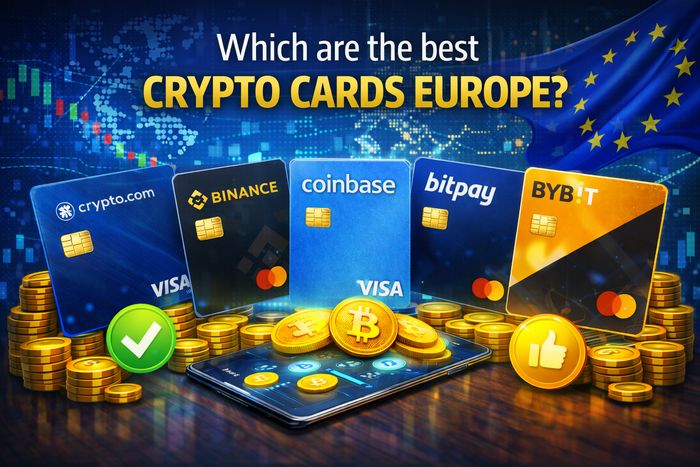
Which Are the Best Crypto Cards in Europe? (2026 Guide)
Crypto cards are one of the easiest ways to bridge crypto and everyday payments in Europe. You top up (or hold) crypto or stablecoins, the card converts when you pay, and merchants receive fiat through the card network—so your checkout experience feels like a normal debit card. The real question isn’t “Which card has the biggest cashback banner?” but: Which card has the lowest total cost for European spending (FX, conversion, ATM, and limits) while staying convenient and secure.
This guide focuses on what matters most for European users—EU/EEA availability, EUR spending, FX fees when traveling, supported assets, and clean record-keeping. We also highlight exchange-linked ecosystems that many Europeans prefer for convenience.
Quick picks: best crypto cards for Europe (by use case)
“Best” depends on your country, how you spend, and whether you want a virtual card, a physical card, or both. Use these categories to shortlist quickly:
- Best for everyday EUR spending: choose a card with predictable EUR settlement, clear conversion rules, and low hidden fees.
- Best for travel in Europe (and beyond): prioritize low FX fees and minimal exchange-rate markup.
- Best for online-first users: a virtual card you can add to mobile wallets can be enough for most purchases.
- Best for budgeting: stablecoin-funded spending (instead of spending BTC/ETH directly) is usually simplest.
If you’re comparing exchange-linked ecosystems, many European users shortlist options connected to Bybit, Bitget, and MEXC first, then cross-check fees and availability in their specific country.
Internal reads you may like: crypto card Europe · crypto debit card · stablecoin spending · crypto tax Europe
How crypto cards work in Europe (and why it matters)
Most crypto cards available to Europeans work in one of these ways:
1) “Auto-convert at purchase” spending
You hold crypto or stablecoins, and the card converts at the moment of purchase. This can be convenient, but you must understand: What rate is used? Is there a conversion fee? Is there any FX markup? These three details determine your real cost per transaction.
2) “Top-up card balance” spending
You top up a card balance (often in EUR) before spending. This can be easier for budgeting because your “card balance” becomes your spending limit. It also reduces surprises if markets move.
3) Virtual card vs physical card
- Virtual card: best for online payments and mobile wallets; often fastest to get.
- Physical card: better for in-store usage everywhere and for some ATM scenarios.
Why does this matter in Europe? Because Europeans commonly spend across borders—EUR to non-EUR (or even EUR to EUR via foreign merchants), and FX rules can silently add cost. The best European crypto cards are typically those with transparent FX policies, stable conversion rules, and reasonable limits.
What to compare: the European crypto card checklist
Step 1: Country eligibility (don’t skip)
- Is your country supported? Card programs can be region-limited and issuer-dependent.
- Is it EU/EEA-friendly? Some cards are marketed globally but have constraints in specific European countries.
- What verification is required? KYC is standard; confirm what documents you’ll need.
Step 2: EUR spending and FX behavior
- EUR base currency: ideal for eurozone users to reduce conversion layers.
- FX fee: what you pay when you spend in a different currency.
- Exchange-rate markup: some providers add a hidden spread beyond network rates.
Step 3: Funding method and conversion logic
- Stablecoins supported? Stablecoin-first spending usually reduces volatility stress.
- Conversion fee? A “small” conversion fee can erase rewards quickly.
- When does conversion happen? At purchase, at top-up, or both?
Step 4: Limits and ATM reality
- Daily/monthly spend limits: crucial if you want to use it as a main card.
- ATM withdrawal limits and fees: many cards have “free tiers” then charge a percentage.
- Weekend/holiday FX behavior: some providers change FX conditions outside market hours.
Quick action (internal)
If you only do one thing: compare FX fee + conversion fee + monthly caps. That trio usually determines the best card in Europe.

Top crypto card options Europeans look at (pros & watch-outs)
Below are the most common categories Europeans compare when choosing a crypto card. Availability, fees, and terms can vary, so treat this as a decision guide rather than a promise of features in every country.
1) Exchange-linked cards (popular for convenience)
Many Europeans prefer exchange-linked card ecosystems because funding the card from trading balances can be simple, and the app experience typically includes card controls and clear transaction history. Bybit, Bitget, and MEXC are frequently shortlisted in this category due to their broad user base and card-oriented ecosystems.
- Pros: one-app experience, easy funding, quick transaction visibility, often strong promos.
- Watch-outs: country availability, issuer partner terms, conversion/FX costs, and spending caps.
2) Tiered “perk” cards
Some cards emphasize perks and tiered rewards. In Europe, this can be attractive if you genuinely use the perks, but it can be expensive if it requires locking large balances or meeting high tier requirements.
- Pros: higher potential cashback, lifestyle perks for frequent users.
- Watch-outs: requirements, caps, and whether rewards are paid in a token that can fluctuate.
3) Fintech-style crypto cards
Some fintechs provide crypto-enabled cards with a “banking app” feel. These can be strong for day-to-day budgeting, but the crypto feature set might be narrower (fewer assets or fewer on-chain options).
- Pros: budgeting tools, cleaner fiat accounting, sometimes lower complexity.
- Watch-outs: fewer supported assets, extra steps to move crypto in/out.
Internal reads: Bybit card · Bitget card · MEXC card · Visa/Mastercard crypto card
Fees Europeans should obsess over (FX, conversion, ATM)
1) FX fee (the silent cashback killer)
Europe is a travel-heavy market. Even if you live in the eurozone, you may spend in non-EUR currencies, or you may be charged by a non-euro merchant. A small FX fee (or rate markup) can quietly cost more than your cashback earns. If you travel often, low FX costs usually matter more than headline rewards.
2) Conversion fee (crypto-to-fiat settlement)
Some cards convert your crypto at the moment of purchase; others convert at top-up. Either way, you must understand: Is there a conversion fee? If yes, what is it, and does it change by asset? For frequent spending, even modest conversion fees add up.
3) ATM withdrawals (limits, thresholds, and operator fees)
If you need cash, check:
- Monthly free ATM threshold: how much you can withdraw before fees start.
- Issuer fee after threshold: often a percentage.
- ATM operator fee: charged by the machine owner (separate from issuer fees).
4) Weekend and out-of-hours conditions
Some providers apply different FX behavior outside business hours or on weekends. If you spend a lot on weekends, confirm whether the exchange rate behavior changes or whether additional buffers apply.
Cashback & rewards: how to compare honestly
Cashback looks simple but often comes with conditions. Here’s how Europeans should evaluate rewards:
- Check caps: “Up to X%” is often capped monthly or limited to specific categories.
- Check payout format: stablecoin vs token vs points vs vouchers (each has different real value).
- Compare to fees: conversion and FX fees can erase rewards—calculate net value.
- Ignore vanity tiers: only chase tiers if you would qualify naturally without locking major funds.
A practical approach: treat cashback as a bonus. Pick the card with the best fee structure for your daily behavior, and let rewards be the extra—not the reason.
Security: non-negotiables for any crypto card
A crypto card should be treated like a bank card with extra protections. Don’t compromise here.
Must-have controls
- Instant freeze/unfreeze inside the app
- Strong authentication (2FA + device protections)
- Card limits & spend controls (online/in-store toggles, if available)
- Clear transaction history and exportable records
Smart habits for Europe
- Use a virtual card for online shopping where possible.
- Keep only a spending balance on the card—store the rest safely.
- Freeze the card when traveling if you won’t use it for a while.
Best setup for Europe: stablecoin-first daily spending
If your goal is practical everyday payments in Europe, a stablecoin-first setup is usually the least stressful:
- Hold your spending budget in stablecoins (instead of spending BTC/ETH directly).
- Top up on a schedule (weekly or monthly) to reduce constant small conversions.
- Track your transactions with exports and consistent labels for taxes/accounting.
- Keep a buffer for recurring charges (subscriptions, utilities).
This method helps Europeans avoid “I spent my crypto at the worst time” moments and can simplify record-keeping.
Internal reads: stablecoin euro · crypto spending strategy · card fees FX
FAQ: Best crypto cards in Europe
Which crypto card is best in Europe?
The best crypto card in Europe is typically the one available in your specific country with the lowest FX and conversion costs, reasonable spend/ATM limits, and strong card controls. Start by verifying eligibility and reading the fee table.
Are crypto cards available across the EU/EEA?
Availability varies by provider and issuer partner. Some cards cover many European countries, while others are limited. Always check eligibility in the application flow for your country.
Do crypto cards in Europe have FX fees?
Many do, especially when spending outside your card’s base currency. Even within Europe, non-EUR spending can trigger FX. If you travel often, prioritize low FX fees and minimal exchange-rate markup.
Is it better to spend stablecoins or BTC/ETH with a crypto card?
For budgeting and reducing volatility surprises, stablecoins are often simpler. Spending volatile assets can complicate tracking and timing. Choose based on your spending goals and record-keeping preferences.
Can using a crypto card create taxable events in Europe?
Potentially yes, depending on your country. In many places, spending crypto can be treated like a disposal. Keep transaction exports and consider stablecoin-first spending for simpler tracking.
What should I check before applying for a crypto card in Europe?
Country eligibility, virtual vs physical availability, EUR/FX behavior, conversion fees, monthly spending/ATM limits, and security features (freeze/unfreeze, 2FA, clear transaction history).