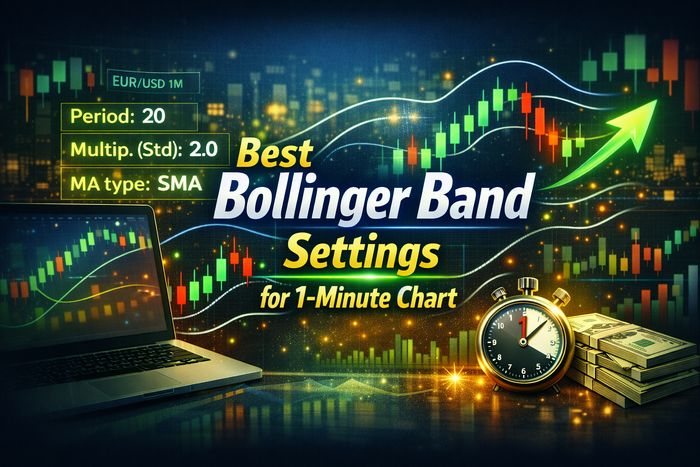
Best Bollinger Band Settings for 1-Minute Chart (1m): A Full Scalping & Volatility Guide
The 1-minute chart is where speed meets noise. Price can tap indicators repeatedly without meaning, fake breakouts are frequent, and small fees/slippage can decide whether a strategy is profitable. That’s why “default” indicator settings often feel inconsistent on 1m.
This guide explains the best Bollinger Band settings for a 1-minute chart and—more importantly—how to choose the right preset for your style: mean reversion, squeeze breakouts, or trend continuation. You’ll also learn practical confirmation rules, stop-loss and take-profit placement, and how to optimize settings without overfitting.
Disclaimer: Educational content only, not financial advice. 1m scalping is high risk.
Why the 1-Minute Chart Needs Different Bollinger Band Settings
Bollinger Bands can work extremely well on the 1-minute timeframe—but only if you respect what 1m actually represents: microstructure, order flow noise, and fast volatility shifts. Compared to 5m or 15m, the 1m chart has:
- Higher noise: more “random” touches of the upper/lower band.
- More fakeouts: quick wicks through levels to trigger stops and trap entries.
- Rapid regime changes: compression → expansion can happen in minutes.
- Higher cost sensitivity: frequent trades amplify fees and slippage.
That’s why the best Bollinger Band settings for 1-minute chart are not a single magic number. The best settings are those that match your setup and filter the noise enough to keep your signals tradeable.

How Bollinger Bands Work (Quick Refresher)
Bollinger Bands consist of a middle band (moving average) and two outer bands based on standard deviation. In simple terms:
- Middle band: a “fair value” reference line (commonly a 20-period SMA).
- Upper band: middle band + (standard deviation × multiplier).
- Lower band: middle band − (standard deviation × multiplier).
- Band width: a live view of volatility—tight bands = compression, wide bands = expansion.
On 1m, Bollinger Bands are best used to identify: volatility squeezes, stretched moves, and trend strength. The bands do not “predict” direction by themselves—you supply direction via trend filters, structure, and confirmation.
Best Bollinger Band Settings for 1-Minute Chart (Presets)
Below are practical presets for the 1-minute chart. Use them as a starting framework, then refine based on your trading style and the asset’s volatility. The key is to avoid over-optimization: keep only a few presets and switch based on regime.
Preset A: Balanced Default (Best Starting Point for Most 1m Traders)
Period: 20 | Standard Deviation: 2.0
- Best for: liquid markets and normal volatility sessions.
- Why it works: stable and widely used; helps you avoid chasing ultra-sensitive signals.
- Use with: trend filter + candle close confirmation.
Preset B: Fast Scalping (More Responsive, Needs Strong Filtering)
Period: 14–18 | Standard Deviation: 1.8–2.0
- Best for: quick mean reversion snaps and micro pullbacks.
- Trade-off: more signals (including bad ones). Only use if you can filter and stay selective.
- Must-have: strict session rules to prevent overtrading.
Preset C: Anti-Chop (Cleaner Extremes, Fewer Traps)
Period: 20 | Standard Deviation: 2.2–2.5
- Best for: volatile altcoins, whippy sessions, and when you’re getting “death by band touches.”
- Why it works: wider bands reduce noise and force price to move more before signaling an “extreme.”
- Trade-off: fewer entries; sometimes later entries.
Preset D: Trend Pullback (Smoother Midline for Continuation Entries)
Period: 20–24 | Standard Deviation: 2.0
- Best for: trend continuation scalps (buy pullbacks in uptrends / sell pullbacks in downtrends).
- Why it works: the middle band becomes a cleaner guide for pullback entries and trade management.
1m Settings Cheat Sheet Table
| Preset | Period | Std Dev | Best Use | Main Risk |
|---|---|---|---|---|
| A: Balanced | 20 | 2.0 | Most conditions | Overtrading touches |
| B: Fast | 14–18 | 1.8–2.0 | Quick scalps | Noise / traps |
| C: Anti-chop | 20 | 2.2–2.5 | Whippy markets | Late entries |
| D: Trend pullback | 20–24 | 2.0 | Continuation trades | Missing sharp reversals |
If you’re unsure where to start, use 20 / 2.0. If signals are too frequent and low quality, widen deviation first (2.2–2.5). If signals feel too slow, reduce the period slightly (20 → 18). Change one variable at a time.

Choose the Best 1m Bollinger Settings by Trading Style
Style 1: 1-Min Mean Reversion Scalping (Range Markets Only)
If you scalp ranges, you want bands that highlight “stretched” moves, then you require a reversal trigger. Suggested presets: A (20/2.0) or B (14–18 / 1.8–2.0).
- Entry idea: band touch + rejection wick + close back inside bands.
- Target: middle band (primary), partial runner if range holds.
- Critical filter: avoid mean reversion against strong higher-timeframe momentum.
Style 2: 1-Min Squeeze Breakouts (Volatility Expansion)
If you trade breakouts, you care about band compression, range definition, and expansion follow-through. Suggested presets: A (20/2.0) or C (20/2.2–2.5) in choppy sessions.
- Entry idea: draw a squeeze “box,” enter on a close outside the box (or on a retest).
- Stop: back inside the box (breakout invalidation).
- Exit: structure target + partial profit + trail if momentum continues.
Style 3: Trend Continuation Pullbacks (Band Ride Logic)
In strong trends, band touches are often momentum confirmation, not reversal signals. Suggested preset: D (20–24/2.0).
- Entry idea: pullback toward middle band + continuation candle.
- Exit: prior micro high/low or trail behind swings.
- Rule: don’t fade the band ride unless momentum clearly breaks.
Internal navigation: if you want to formalize your trading plan, jump to 1m risk management rules and make them non-negotiable.
What Band Touches Really Mean on a 1-Minute Chart
On 1m, a band touch is a condition, not a command. Here’s the practical interpretation:
- Touch in a range: possible exhaustion → look for rejection + reclaim.
- Touch in a trend: often strength → look for continuation, not reversal.
- Repeated touches: momentum “walking the band.” Countertrend trades become lower probability.
- Tight bands: compression → prepare for breakout rules, not reversal rules.
Your job is to label the regime first. Then you apply the matching rule set.
Confirmations That Reduce False Signals on 1m
The 1-minute chart is noisy. Confirmations help you trade fewer, higher-quality signals. You don’t need ten indicators—just a small set that covers trend, momentum, and participation.
1) Higher Timeframe Bias (5m or 15m “Compass”)
A quick glance at 5m/15m helps you avoid fighting strong momentum. If higher timeframe trend is clear, prefer trades in that direction and reduce countertrend mean reversion.
2) RSI (Momentum + Divergence)
- Divergence: price makes a new extreme at the band but RSI does not → reversal probability increases.
- Momentum sustain: if RSI stays strong in trend direction, band touches often continue.
3) Volume / Activity
Breakouts with rising activity tend to follow through more often than low-volume pokes. If a breakout occurs on weak participation, expect snap-back risk.
4) Price Action Triggers
Use the bands to define the zone, then use price action to trigger the trade: rejection wicks, strong closes, engulfing candles, and clear micro structure breaks.
Risk Management Rules for 1-Minute Bollinger Trading
The fastest way to fail on 1m is overtrading + weak stops. Your edge must survive noise and costs. These rules keep the strategy stable:
Rule 1: Stops Must Be Structure-Based
- Mean reversion: stop beyond the swing extreme that invalidates the reversal.
- Breakout: stop back inside the squeeze range (box).
- Trend pullback: stop beyond the pullback swing; exit if structure breaks.
Rule 2: One Clean Target + Optional Runner
- Mean reversion target: middle band first (high-probability exit).
- Breakout/trend target: next structure level, then trail if momentum remains.
Rule 3: Hard Limits (To Prevent Overtrading)
Set a maximum number of trades per session and a maximum drawdown (daily stop). If you hit it, stop. 1m trading punishes emotional spirals.
Rule 4: Track Net Results After Fees
A strategy can look great on charts and fail live. Track your net outcomes after fees and typical slippage. If your average win is too small, widen targets or reduce frequency.
How to Optimize Bollinger Band Settings for 1m (Without Overfitting)
The best traders don’t constantly change settings. They keep a small set of presets and switch them based on regime. Here’s a simple optimization process that works:
Step 1: Pick a Strategy Family
Choose one: mean reversion, squeeze breakout, or trend pullback. Each prefers different settings and confirmations. Mixing them randomly creates inconsistent results.
Step 2: Test a Small Grid
Keep it tight: Periods: 14, 18, 20, 24 | Deviations: 1.8, 2.0, 2.2, 2.5
Step 3: Validate Across Conditions
- Ranging sessions
- Trending sessions
- Choppy/high-volatility sessions
Step 4: Change One Variable at a Time
- Too many false signals? Increase deviation (wider bands).
- Signals too late? Reduce period slightly (more responsive).
Internal tip: if your site has a “Trading Checklist” page, link it here in WordPress using your real slug later. For now, keep navigation inside this article with anchors like Confirmations.

Where Traders Test 1m Bollinger Presets (Bybit, Bitget, MEXC)
1m strategies require consistent charting, fast execution, and liquid markets. Many traders test and apply these presets on major exchanges with active order flow. If you want commonly used platforms for active crypto markets, consider BYBIT, BITGET, and MEXC.
Best practice: save two templates (breakout vs mean reversion) and keep a strict risk checklist. Your process matters more than the exact numbers.
FAQ: Best Bollinger Band Settings for 1-Minute Chart
What are the best Bollinger Band settings for a 1-minute chart?
A strong starting point is 20 period with 2.0 standard deviations. For faster scalping signals, try 14–18 with 1.8–2.0. If markets are choppy and you’re getting false touches, consider wider bands like 20 / 2.2–2.5.
Should I use SMA or EMA for the middle band on 1m?
SMA is the classic approach, while EMA reacts faster. If your entries feel late, testing an EMA can help, but keep your rules consistent and re-check performance after fees.
Do Bollinger Bands work for 1m scalping?
They can, especially for squeeze breakouts and trend pullbacks, but you must use confirmations and strict risk limits. 1m noise makes “band touch = reversal” unreliable without context.
How do I avoid fake signals on the 1-minute chart?
Use a higher-timeframe bias (5m/15m), a momentum tool like RSI, and volume/activity confirmation for breakouts. Prefer candle closes and reclaims over wick-based signals.
How often should I change my 1m Bollinger settings?
Avoid constant changes. Keep 2–3 presets and switch only when volatility regime clearly shifts (range → chop → trend). Track outcomes and adjust gradually rather than optimizing daily.
Need a quick review? Jump back to 1m preset settings or risk management rules.