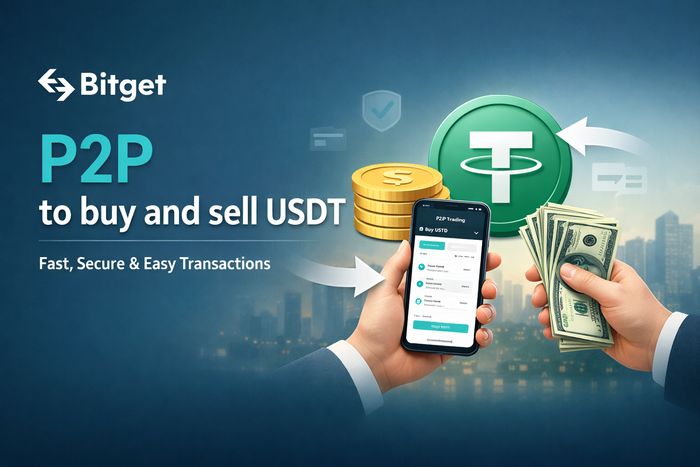
Bitget P2P to Buy and Sell USDT: 2026 Complete Guide
How to Use Bitget P2P to Buy and Sell USDT: The 2026 Safety-First Guide
In the world of crypto, stablecoins like USDT are the fuel for trading. But getting that fuel—converting your local currency into USDT—can be a bottleneck. Bank transfers are slow, card payments get declined, and fees eat into your capital. Bitget P2P (Peer-to-Peer) offers a direct solution: a marketplace where you buy USDT from other users using your preferred local payment method, with the exchange acting as a secure escrow. In 2026, with Bitget’s updated zero-fee structure for many markets, P2P trading has become one of the most cost-effective and flexible on-ramps and off-ramps for crypto . This guide provides a complete playbook for using Bitget P2P to buy and sell USDT safely and efficiently.
⚡ Key Takeaways: Mastering Bitget P2P
- Zero-Fee Advantage: Bitget P2P currently charges 0% fees on trades, making it one of the most cost-effective options for converting fiat to USDT .
- Escrow Protection: Bitget holds the seller’s USDT in escrow during the transaction. The crypto is only released to the buyer after the seller confirms receipt of funds .
- Payment Flexibility: Access over 100 payment methods, including bank transfers, digital wallets (Payeer, Wise), and local options, giving you control over how you pay or get paid .
- Strategic Tool: P2P isn’t just for buying—it’s a powerful way to sell USDT for local currency, often at premium rates, and to fund your Bitget spot wallet for further trading.
- The Hidden Risk: The biggest danger isn’t the platform—it’s counterparty fraud. Following the platform’s rules and never communicating off-platform is your #1 defense.
📑 Table of Contents
- 1. At-a-Glance: Bitget P2P vs. Other On-Ramps
- 2. Methodology: How We Evaluate P2P Platforms
- 3. What is Bitget P2P? (And Why USDT?)
- 4. Step-by-Step: How to Buy USDT on Bitget P2P
- 5. „Best For” Use-Case Scenarios
- 6. Three Ready-to-Use P2P Templates
- 7. The Hidden Costs Formula (With Worked Example)
- 8. 6 Common P2P Problems & Fixes
- 9. The User Voice: Real Experiences
- 10. Frequently Asked Questions
📊 At-a-Glance: Bitget P2P vs. Other On-Ramps
To understand where Bitget P2P excels, here’s how it stacks up against other methods for buying USDT.
| Feature | Bitget P2P | Credit/Debit Card | Bank Transfer |
|---|---|---|---|
| Platform Fee | 0% (currently) | 1-3.5% + FX fees | 0.1% (spot) + wire fees |
| Speed | Minutes (depends on seller) | Instant | 1-5 business days |
| Payment Methods | 100+ (local banks, e-wallets) | Visa/Mastercard only | Bank account only |
| Counterparty Risk | Mitigated by escrow | N/A (platform is counterparty) | N/A |
| Best For | Local currency, zero fees, flexibility | Immediate small purchases | Large, non-urgent transfers |

🧠 Methodology: How We Evaluate P2P Platforms
To provide reliable recommendations, we assess P2P platforms against a strict framework based on real-world trading conditions . Here’s what we look at:
- Fee Transparency: Does the platform charge hidden fees, or are costs clearly shown? Bitget’s 0% fee policy is verified through multiple sources .
- Escrow Reliability: How robust is the escrow process? We test whether the platform properly holds assets and has a clear dispute resolution path .
- Merchant Ecosystem: Are there enough active, reputable merchants with competitive prices in your region? Liquidity matters .
- Payment Method Coverage: Does the platform support the local payment rails you actually use (e.g., specific banks, e-wallets)?
- Dispute Handling: We analyze the clarity of dispute rules and the responsiveness of support when trades go wrong .
🤝 What is Bitget P2P? (And Why USDT?)
Bitget P2P is a marketplace that connects buyers and sellers of cryptocurrency directly. Bitget acts as a trusted intermediary, providing an escrow service—when a seller lists USDT for sale, those tokens are locked by Bitget. They are only released to the buyer once the seller confirms receipt of the fiat currency payment .
Why USDT? Tether (USDT) is the most traded stablecoin on P2P platforms. It serves as a stable bridge between your local currency and the volatile crypto market. Once you buy USDT via P2P, you can use it to:
- Trade for other cryptocurrencies (BTC, ETH, altcoins) on Bitget’s spot market.
- Use it as margin for futures trading or copy trading.
- Transfer it to Bitget Wallet for DeFi interactions .
- Hold it as a stable store of value.
For a broader perspective on automated investing, see our guide on how to use Bitget Recurring Buy for effortless crypto purchases.
🛠️ Step-by-Step: How to Buy USDT on Bitget P2P
Here is the exact workflow for a safe and successful P2P purchase, based on Bitget’s official processes .
Step 1: Navigate to Bitget P2P
Log in to your Bitget account. From the top menu, select „Buy Crypto” > „P2P Trading”. This opens the P2P marketplace.
Step 2: Set Your Filters
Optimize your search:
- You Want to Buy: Select „Buy” and „USDT”.
- Fiat Currency: Choose your local currency (USD, EUR, NGN, etc.).
- Payment Method: Select your preferred method (e.g., Bank Transfer, Wise, Payeer). This is crucial for finding relevant offers .
Step 3: Choose a Merchant
Review the list of offers. Look beyond just the price:
- Completion Rate: Aim for merchants with 95%+ completion.
- Trade Limits: Ensure your desired amount falls within the merchant’s min/max limits.
- Orders: A high number of completed orders indicates reliability .
Step 4: Place an Order and Pay
Click „Buy USDT” on your chosen offer. An order page opens with the merchant’s exact payment details. Important: You must send payment exactly as described—using the reference number if required—and only to the account details shown inside this order page.
Step 5: Mark as Paid and Wait for Release
After sending the payment via your banking app, return to Bitget and click „Transferred, Notify Seller”. The USDT is in escrow. The seller now verifies receipt of funds. Once confirmed, they will release the USDT from escrow, and it will appear in your Bitget Spot wallet .
Step 6: (For Sellers) Release USDT
If you are selling, after confirming the fiat has landed in your bank account, you must go to the order and click „Release”. Never release before confirming funds in your own account .
🎯 „Best For” Use-Case Scenarios
Here’s when Bitget P2P is the ideal tool, and when you might consider alternatives like Bybit or MEXC.
| Use Case | Why Bitget P2P Wins | Alternative |
|---|---|---|
| Zero-Fee USDT Top-Up | Bitget’s 0% fee policy minimizes costs for frequent traders . | Bybit for card cashback if spending directly. |
| Local Currency Access (e.g., NGN) | Bitget’s focus on local markets like Nigeria with zero taker fees provides deep liquidity . | MEXC for larger single transactions. |
| Selling USDT for Premium | P2P often allows sellers to set prices above the spot rate, capturing a premium from buyers needing local currency. | Direct card sales (less common). |
| Privacy-Conscious Funding | You share payment details only with the counterparty for that trade, not the entire platform. | DEX for full anonymity, but with complexity. |
| Funding Bitget Ecosystem | Direct USDT purchase feeds instantly into spot wallet for trading, bots, or futures . | External wallet transfer (slower, network fees). |
📝 Three Ready-to-Use P2P Templates
Here are three concrete plans based on different goals. These are actionable checklists, not hypotheticals.
Template A: The „First-Time Buyer” ($50)
Goal: Safely purchase $50 worth of USDT to test the P2P waters.
- Platform: Bitget P2P.
- Setup: Filter for „Buy USDT” with your currency. Choose a merchant with 500+ orders and a >98% completion rate. Use your most familiar payment method (e.g., bank transfer).
- Execution: Send payment exactly as instructed. Keep the banking app open. Mark as paid. The USDT should arrive in <15 minutes.
- Cost: $50 + 0 fee. Spread may be slightly above spot price—this is the merchant’s premium.
Template B: The „Scale-Up Seller” ($1,000 USDT to Sell)
Goal: Sell 1,000 USDT for local currency at a competitive rate, minimizing risk.
- Platform: Bitget P2P.
- Setup: Go to „Sell” USDT. Post an ad or accept a buyer’s offer. Ensure your USDT is in your Spot wallet.
- Execution: Wait for the buyer to pay. Check your bank account—do not rely on SMS only. Confirm the exact amount has landed. Then release USDT from escrow .
- Cost: 0% fee. Your profit is the premium over spot you negotiated.
Template C: The „Trader’s Fund” ($500 for Futures)
Goal: Quickly fund your Bitget futures account to capitalize on a trading signal.
- Platform: Bitget P2P.
- Setup: Buy USDT via P2P with a fast payment method (e.g., Payeer, Wise) that settles instantly .
- Execution: Complete P2P purchase. Once USDT is in Spot, transfer to your Futures account (0 fee internal transfer) and open your position.
- Integration: Use the USDT to activate a copy trading strategy or manual futures trade. Learn more about automated tools in our recurring buy guide.
💰 The Hidden Costs Formula (With Worked Example)
P2P trading has zero platform fees, but that doesn’t mean it’s free. Here’s the formula to calculate your true all-in cost .
Worked Example: Buying $200 USDT
- Scenario: Spot price of USDT is $1.00. You find a P2P merchant selling at $1.02.
- Step 1 (Merchant Premium): ($1.02 – $1.00) / $1.00 = 2% premium. On $200, that’s $4.
- Step 2 (Payment Provider Fee): Your bank charges a $1 fee for the transfer.
- Step 3 (Opportunity Cost): The 10 minutes you spent waiting for the seller to confirm.
- The Math: $4 (premium) + $1 (bank fee) = $5 total cost (2.5% of your investment).
Solution: Compare multiple merchants. Sometimes a slightly higher price from a merchant with instant release is worth the lower time cost. Also, use payment methods with zero transfer fees.
🚨 6 Common P2P Problems & Fixes
Based on user reports and our analysis, here are the most frequent P2P issues and how to resolve them .
- Problem: Seller is not releasing USDT after you paid.
Fix: First, wait the required time (usually 15-30 minutes). If still not released, click „Appeal” in the order. Upload your payment proof (screenshot, transaction ID) in the appeal chat. Bitget support will review and release the USDT if your proof is valid . - Problem: Buyer claims they paid, but you don’t see the money.
Fix: Do NOT release the USDT. Check your bank account carefully. If funds aren’t there, reject the release and open an appeal. Some payment methods are not instant and can be reversed . - Problem: Order was cancelled after you paid.
Fix: If you paid and the order was cancelled, the USDT is returned to the seller’s escrow, not to you. Immediately open an appeal with your payment proof. This is a serious issue requiring support intervention. - Problem: Can’t find offers for your payment method.
Fix: Broaden your payment method filter. If you use a niche local bank, try adding „All” payment methods to see what’s available, then adapt . - Problem: You accidentally paid from the wrong bank account.
Fix: Contact the merchant immediately via the order chat. Explain the situation. If they agree to confirm, they can still release. If not, you may need to appeal, but success depends on merchant cooperation. - Problem: Merchant asks you to mark as paid before you actually pay.
Fix: Never do this. Scammers use this to claim you paid and try to get the crypto released. Only click „Transferred, Notify Seller” after you have physically sent the money .
🗣️ The User Voice: Real Experiences
We compiled feedback from traders using Bitget P2P in 2026.
💬 „I’ve been using Bitget P2P for Naira transactions for months. The zero-fee structure is a game-changer. I can buy USDT at competitive rates and fund my futures account instantly.” — User on Vanguard News comments
💬 „Had a dispute once where the seller was late releasing. I opened an appeal with my payment screenshot, and support resolved it within an hour. The escrow system works.” — u/cryptouser22, Reddit
💬 „The range of payment methods is what keeps me on Bitget. I can use my local e-wallet directly, avoiding bank delays. It’s the most flexible on-ramp I’ve found.” — Review on Bitget Academy
❓ Frequently Asked Questions
What are the fees for Bitget P2P trading?
How does Bitget P2P escrow protect me?
Can I sell USDT on Bitget P2P for cash?
What happens if the seller doesn’t release USDT after I paid?
What payment methods are supported on Bitget P2P?
Is Bitget P2P safe?
How long does a P2P trade take?
Do I need KYC for Bitget P2P?
Can I use Bitget P2P in Nigeria?
How do I withdraw money from Bitget P2P?
⚠️ Educational, Not Financial Advice: This article is for informational purposes only and does not constitute financial advice. Cryptocurrency investments are volatile and carry risk. Always do your own research (DYOR) and consult with a qualified financial advisor before making investment decisions.
🔗 Affiliate Disclosure: Some links on this page are affiliate links, meaning we may earn a commission if you sign up through them, at no additional cost to you. We only recommend products we believe in.