Funding Rate in Crypto: The Complete 2025 Handbook for Perpetual Futures
Everything you need to understand funding rates in crypto perpetual futures: what funding is, why it exists, how exchanges compute it, how it affects your PnL and liquidation risk, and how traders use funding data for strategies—from delta-neutral carry to contrarian squeeze plays. Jump to the table of contents.
What Is the Funding Rate?
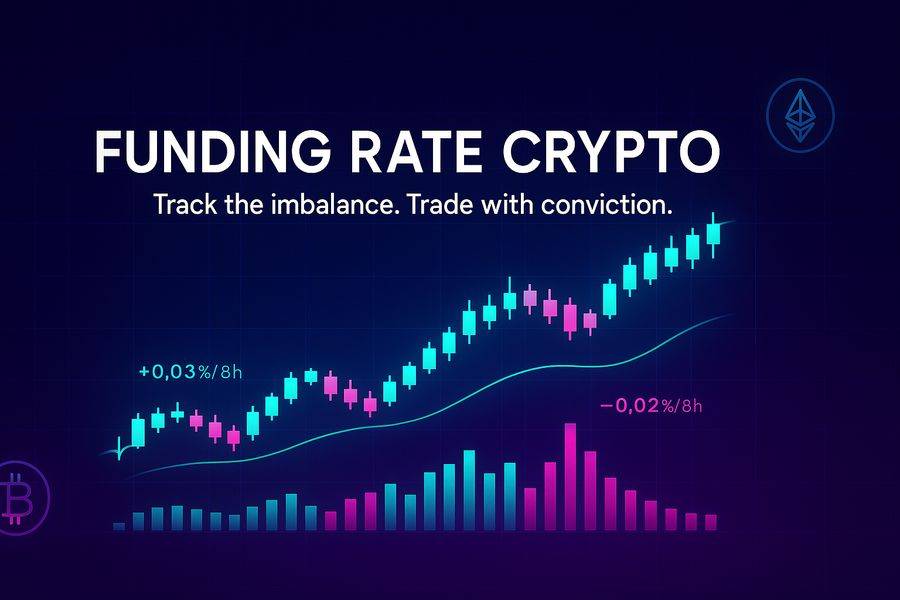
The funding rate is a periodic payment exchanged between longs and shorts on perpetual futures. It keeps the perp price anchored to an index (spot basket). If the perp trades above index, the funding rate turns positive and longs pay shorts; if the perp trades below index, funding is negative and shorts pay longs. Funding is not an exchange fee; it is a peer-to-peer transfer that directly impacts your unrealized/realized PnL at each funding event.
Why Funding Exists (Index Peg & Perps 101)
Perpetual swaps have no expiry date. Without a natural settlement, prices could drift far from spot. Funding creates an economic incentive to align the perp with the index price: traders on the “rich” side of the market pay those on the “cheap” side, encouraging mean reversion of the basis.
How Funding Is Calculated
Implementations differ by venue, but the structure is similar. A simplified view for linear USDT-margined perps:
Premium component
Exchanges estimate the premium (how far the perp deviates from index/mark). Higher premium → more positive funding; discount → negative funding.
Interest component
Some venues incorporate an interest rate differential between base and quote assets. Net funding is premium ± interest, often clamped within a cap per interval.
Clamping & smoothing
- Funding rates are typically bounded each interval (e.g., ±0.05%/interval), with smoothing windows to reduce spikes.
- Predicted funding (next interval estimate) is displayed in advance; the final rate is fixed at the interval boundary.
Note: Exchanges compute funding off the mark price—an index-derived fair value—to reduce manipulation. Your PnL and liquidation checks reference the mark, not the last trade.
Funding Payments: The Math
For a linear USDT-margined perp, the per-interval payment (ignoring fees) is:
Funding Payment = Position Notional × Funding Rate (per interval)
Direction: Positive rate → longs pay; negative rate → shorts pay.
Annualization (approx.):
Annualized Rate (APR) ≈ Funding Rate per interval × (Intervals per year)Example: 0.01% per 8 hours → ~0.01% × 3 × 365 ≈ 10.95% APR (simple, not compounded).
Schedules, Caps & Mark-Price Nuances
- Intervals: Common schedules are every 8 hours (3×/day) or hourly on some markets.
- Caps: Per-interval caps limit extreme values; cumulated funding can still be large during prolonged dislocations.
- Who pays when flat? No position → no funding. Funding applies only to open notional during the timestamp cut.
- Realization: Some venues realize funding continuously to equity; others book it discretely per interval.
Signals: Reading Funding Like a Pro
1) Crowding sentiment
Persistent positive funding → longs are crowded; persistent negative funding → shorts are crowded. Crowding + thin liquidity increases squeeze risk.
2) Regime context
Funding extremes behave differently in trends vs. ranges. In a strong uptrend, positive funding can persist; in choppy markets, extremes often mean-revert.
3) Cross-asset & cross-venue divergence
When one exchange shows significantly higher funding than peers, traders may route shorts there to collect. Divergences often precede volatility.
Strategies Built Around Funding
Delta-neutral carry (basis/funding capture)
Construct a position that is market-neutral but earns funding. Two common variants:
- Perp short + spot long: If funding is positive and expected to persist, short the perp and hold the underlying (or a proxy) to stay delta-neutral while receiving funding.
- Perp long + spot short/borrow: If funding is negative, invert the structure (operationally trickier because of borrow/frictions).
Costs to model: trading fees, borrow rates (for short spot or margin), slippage, and transfer costs. Track net carry after all frictions.
Momentum with funding confirmation
Use funding sign and trend direction together: trade with the trend when funding is modest; fade only when funding hits extremes and momentum stalls.
Cross-exchange relative value
Short the higher-funding venue and long the lower (or opposite) while hedging exposure to capture the differential—requires robust ops and inventory management.
Event-driven hedging
Before catalysts (listings, macro prints), tighten exposure if funding becomes lopsided. Dislocations can reverse quickly after the event.
On-ramp and execution
For liquidity and account setup, many traders compare centralized venues. Examples include BITGET, BYBIT, and MEXC. Keep the number of active venues small to simplify risk and settlements.
Risks, Hidden Costs & Operational Pitfalls
- Funding flips: Positive can turn negative quickly; don’t extrapolate blindly.
- Fees & slippage: Often exceed funding for short windows—especially during volatility or thin books.
- Borrow constraints: Shorting spot or borrowing stables may be capacity-limited and rate-sensitive.
- Liquidation risk: Funding is PnL-active; if you pay funding while price moves against you, equity erodes faster. Keep liquidation distance generous.
- Operational load: Cross-venue arbitrage requires transfers, wallet hygiene, and monitoring of withdrawal/network fees.
Worked Examples (Long/Short, Cross/Isolated)
Example 1 — Long perp paying funding
- Position notional: 50,000 USDT; funding: +0.01% per 8h; interval: 3×/day.
- Daily funding paid by long:
50,000 × 0.0001 × 3 = 15 USDT/day. - If average edge is 12 bps/day, fees + slippage must be <12 bps or the trade loses money.
Example 2 — Delta-neutral carry (short perp, long spot)
- Short perp notional: 100,000 USDT; funding: +0.02%/8h (receive); spot long: 100,000 USDT equivalent.
- Gross daily funding received:
100,000 × 0.0002 × 3 = 60 USDT/day. - Subtract maker/taker, borrow (if any), conversion/withdrawal. Net carry must remain positive with stress to be worthwhile.
Example 3 — Funding and liquidation interaction
Cross margin wallet 2,000 USDT; long perp notional 40,000 USDT; paying +0.015%/8h. Over two days, funding paid ≈ 40,000 × 0.00015 × 6 = 36 USDT. If price also moves −2%, unrealized loss is 800 USDT. Equity drops by 836 USDT total—bringing liquidation materially closer. Respect compounding risks.
Trader’s Checklist
- Know the interval, cap, and mark-price rules for your market.
- Track both realized and predicted funding; don’t rely on predictions alone.
- Model all frictions: fees, slippage, borrow, transfers, network costs.
- Maintain generous liquidation distance; stops should trigger before liquidation.
- Size positions so a funding flip won’t erase your edge.
- Limit venues; reconcile wallets and approvals weekly.
FAQ: Funding Rate Crypto
Is funding a fee paid to the exchange?
No. Funding is a peer-to-peer transfer between longs and shorts. Exchanges facilitate it and may take trading fees separately.
Why did I pay funding even though price went my way?
Funding is independent of your trade direction. If the rate is positive, longs pay regardless of short-term price movement.
How do I annualize funding?
Multiply the per-interval rate by the number of intervals per year (simple). For compounding, use (1 + r_interval)^(intervals) − 1.
Do all exchanges use the same formula?
No. Formulas differ (premium vs. interest weighting, caps, smoothing). The direction convention (positive → longs pay) is common on linear USDT perps.
Can funding be used as a signal?
Yes. Persistent positive/negative funding indicates crowding; extremes often precede squeezes in range-bound regimes. Use with trend and liquidity context.
Start Safely — One CTA
Practice with small size, model total costs, and verify funding assumptions live before scaling. When you need centralized liquidity to fund your strategy, start on a reputable venue and withdraw to self-custody once settled.
Get started on BITGET → test your funding assumptions
Prefer another venue? Explore BYBIT or compare with MEXC. (We limited partner links to a total of three.)