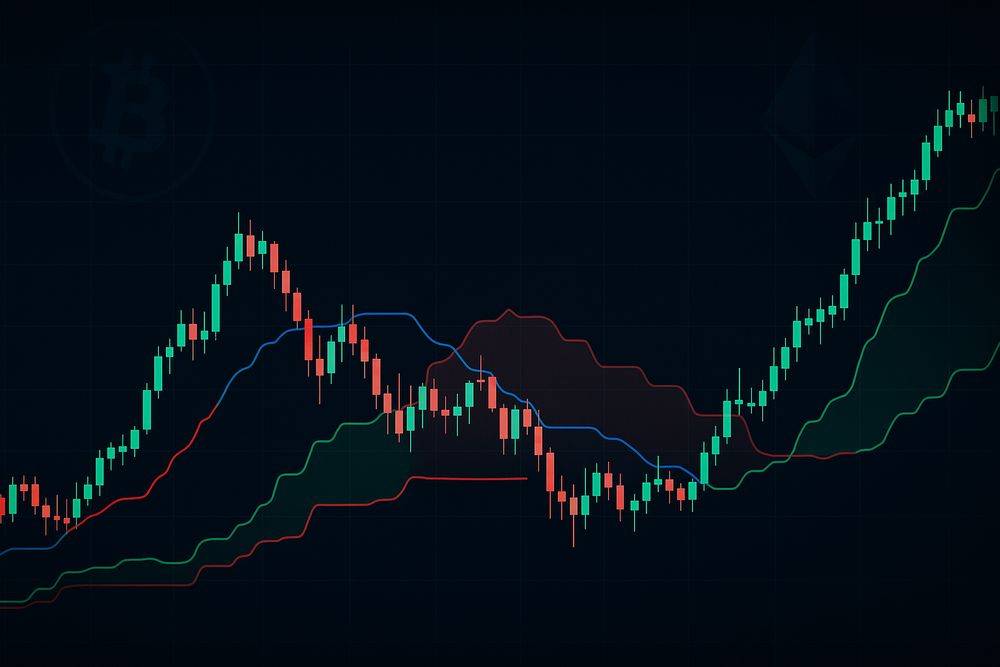
Ichimoku Cloud for Crypto: The Complete, Practical Guide
The Ichimoku Kinko Hyo (“one glance equilibrium chart”) offers an integrated view of trend, momentum, and support/resistance. This guide explains each component, how to read Bitcoin/altcoin charts with the cloud, and how to build objective rules you can backtest before risking real capital.
What Is Ichimoku Cloud?
Ichimoku Cloud is a multi-component system that visualizes price equilibrium at a glance. It combines moving-average–like baselines with forward-shifted “cloud” projections to show likely support/resistance and trend direction. In crypto’s 24/7 market, Ichimoku can help you filter noise, spot breakouts, and manage trades with structure-based rules.
Components & Default Settings
- Tenkan-sen (Conversion Line): midpoint of the last 9 periods (fast baseline).
- Kijun-sen (Base Line): midpoint of the last 26 periods (slow baseline / equilibrium).
- Senkou Span A: (Tenkan + Kijun)/2 plotted 26 periods ahead.
- Senkou Span B: midpoint of the last 52 periods plotted 26 periods ahead.
- Kumo (Cloud): area between Span A and Span B (projected support/resistance & trend bias).
- Chikou Span (Lagging Line): current close plotted 26 periods back (context & confirmation).
Default parameters: 9-26-52. They are a robust starting point across timeframes; adjust cautiously and always validate with backtests.
Reading the Cloud: Core Signals
1) Trend Bias
- Bullish: price above the cloud; cloud often green (Span A > Span B).
- Bearish: price below the cloud; cloud often red (Span A < Span B).
- Neutral/Transition: price inside the cloud — expect chop or a base-building phase.
2) TK Cross (Tenkan–Kijun Cross)
- Bullish TK: Tenkan crosses above Kijun (stronger if above the cloud).
- Bearish TK: Tenkan crosses below Kijun (stronger if below the cloud).
3) Kumo Breakouts
- Break and close above/below the cloud signals potential trend initiation. A twist (Span A crossing Span B) can foreshadow bias change.
4) Kijun Pullback / Equilibrium
- In trends, price often reverts to the Kijun. Pullbacks to Kijun with continuation signals can offer entries with defined risk.
5) Chikou Confirmation
- Bullish context is stronger when Chikou prints above price; bearish when below. Avoid longs if Chikou is blocked by prior price congestion.
Crypto-Specific Settings
Crypto trades 24/7 with regime shifts in volatility and liquidity. While 9-26-52 is a solid baseline, traders sometimes test alternatives (e.g., slightly faster or slower triplets) to align with their timeframe and costs. Regardless of parameters, only adopt adjustments that hold up across out-of-sample tests — avoid curve fitting to one coin or month.
Ichimoku Strategy Templates
A) Cloud Trend-Following (Baseline)
- Context: price and Chikou above the cloud; cloud bullish.
- Entry: TK bullish cross or pullback to Kijun that holds; enter on candle close.
- Stop: below Kijun or below the cloud boundary (Senkou B).
- Targets: prior swing highs, measured moves; consider trailing below Kijun or inside the cloud.
B) Kumo Breakout + Retest
- Setup: price breaks and closes out of the cloud with expanding range.
- Trigger: retest of the cloud edge (or Kijun) holding as support/resistance, confirmed by TK alignment.
- Invalidation: decisive close back inside the cloud.
C) Range Fade with Cloud Filter
- Context: price inside the cloud (balance). Use range extremes with tight risk.
- Exit/Flip: if a breakout turns into a trend (close outside cloud + TK alignment), switch to trend-following rules.
D) Multi-Timeframe Alignment
- Use 4h/1D cloud for bias; execute on 15m/1h with TK crosses or Kijun pullbacks in the HTF direction.
Confluence & Filters
- Structure: align with higher highs/higher lows (uptrend) or lower highs/lower lows (downtrend).
- Trend/Momentum: 200 EMA/SMA, MACD/RSI flips to confirm bias.
- Volume/Footprint (optional): expansion on breakouts; absorption on pullbacks to Kijun/cloud edge.
- Time: avoid thin-liquidity windows if slippage is a concern.
Risk Management & Trade Math
- Position sizing: risk a small fixed fraction per trade (e.g., 0.5–2%).
- Stops: beneath Kijun/cloud for longs (above for shorts) or use ATR buffers.
- Targets: scale at prior structure highs/lows; trail under Kijun or use a chandelier/ATR trail.
- Costs: include fees, funding, and slippage—especially on low timeframes or frequent scaling.
- Correlation: cap total exposure across highly correlated coins.
Double-check fees, TP/SL and ROI per trade with our tool: Free Crypto Profit Calculator.
Backtesting & Optimization
Test your Ichimoku rules on multiple symbols and regimes (bull, bear, chop). Keep rules objective: define exactly what counts as a TK cross entry, a valid cloud breakout, and stop/target placement. Use realistic frictions and maintain a clean out-of-sample set; consider walk-forward validation to mimic live adaptation.
Illustrative Rule Set
- Bias: 4h price above cloud, Chikou above price.
- Entry (1h): bullish TK cross or Kijun pullback that holds; enter on candle close.
- Stop: below Kijun or below the cloud’s Senkou B; add ATR buffer.
- Targets: partial at prior swing; trail remainder below Kijun until opposite TK cross or close back inside the cloud.
Only scale up if live results (win rate, average R, drawdown) resemble your backtest signature.
Common Pitfalls & Pro Tips
- Over-optimizing parameters: small tweaks can look great in-sample but fail out-of-sample.
- Trading inside the cloud blindly: accept that it’s a chop zone; reduce size or wait for clarity.
- Ignoring Chikou: blocked Chikou often foreshadows failed follow-through.
- Costs and latency: frequent low-TF entries can see edge eroded by fees and slippage—model them.
Ready to test your Ichimoku strategy—carefully?
Open accounts with top exchanges and start with small size after a solid paper-trade period:
Verify your fees and TP/SL math here: Free Crypto Profit Calculator.
FAQ: Ichimoku Cloud in Crypto
What are the default Ichimoku settings?
The classic parameters are 9-26-52 (Tenkan, Kijun, Senkou B). They’re a robust starting point across timeframes.
Which timeframe works best?
No single best. Many traders use 4h/1D for bias and 15m/1h for entries. Higher timeframes are cleaner; lower timeframes provide more signals but more noise and fees.
How do I reduce false signals?
Combine Ichimoku with structure, look for Chikou confirmation, and avoid trading blindly inside the cloud. Model fees and slippage.
Is Ichimoku good for scalping?
It can be, with stricter rules (e.g., only trade in the HTF direction, require strong TK alignment) and tight cost control.
Where do I place stops and targets?
Common placements are beyond Kijun or cloud boundaries, with ATR buffers. Targets can use prior structure or a trailing exit below Kijun.