Volume Profile in Crypto: The Complete, Practical Guide
Volume Profile shows how much volume traded at each price level, revealing fair value zones, supply–demand imbalances, and potential turning points. This guide explains the concepts, how to plot profiles correctly, and how to build objective trading rules around them.

What Is Volume Profile?
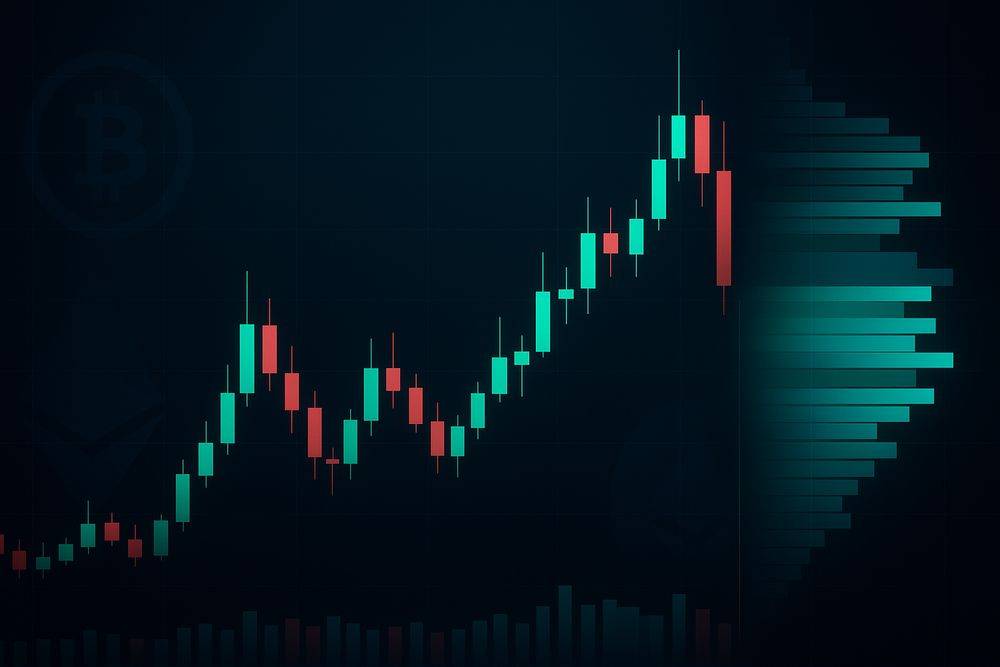
Volume Profile is a histogram plotted on the price axis that shows traded volume at each price level over a chosen period. Unlike time-based indicators, it focuses on where market participants actually transacted, helping identify fair value (balance) vs imbalance areas.
- Balance (value): price rotates around a fairness zone where buyers and sellers agree.
- Imbalance: price moves quickly through low-volume areas where little trading occurred.
Core Elements: POC, VAH/VAL, HVN/LVN
- POC (Point of Control): price level with the highest traded volume (the day’s or range’s “fairest” price).
- Value Area (VA): typically ~70% of volume around POC.
- VAH: Value Area High — upper bound of value.
- VAL: Value Area Low — lower bound of value.
- HVN (High Volume Node): local peaks in the profile; price tends to slow or rotate here.
- LVN (Low Volume Node): local valleys; often act as support/resistance for swift moves and breakouts.
Types of Profiles: Session, Fixed-Range, Composite
Session/Periodic Profile
Each profile covers a session (e.g., daily). In 24/7 crypto, many traders still analyze “daily sessions” to compare structure day-to-day.
Fixed-Range (VPVR) Profile
Draw over a specific swing or consolidation to study where value formed within that move.
Composite (Multi-week/Month)
Aggregate over large windows to find long-term POCs and macro HVN/LVN zones that attract or repel price.
How to Plot Volume Profile (Step by Step)
- Choose scope: session (daily), fixed-range (last swing), or composite (macro).
- Set inputs: visible range or defined start/end. Keep bin size consistent when comparing ranges.
- Mark levels: POC, VAH, VAL, key HVNs/LVNs.
- Align with structure: draw swing highs/lows and trend filters (e.g., 200 EMA/SMA).
- Plan rules: entry confirmation (e.g., candle close, footprint clue), stops and targets before execution.
Verify your trade math (fees, TP/SL, ROI) with our tool: Free Crypto Profit Calculator.
Reading Profiles: Acceptance vs Rejection
- Acceptance: multiple closes and rotations inside value; price gravitates to POC.
- Rejection: quick tails/wicks at VAH/VAL or LVNs; price leaves an area decisively.
- Value migration: POC/VA shift upward (bullish continuation) or downward (bearish continuation).
- Single-print style zones: very thin volume areas often get filled later or act as breakout lanes.
Strategy Templates with Objective Rules
A) Value Rotation to POC (Mean-Reversion)
- Context: balanced day/composite where price rotates between VAH and VAL.
- Long idea: reaction near VAL → target POC; stop below VAL swing.
- Short idea: reaction near VAH → target POC; stop above VAH swing.
- Filters: avoid trend days (value migrating strongly).
B) LVN Breakout/Continuation
- Context: price coiling near an LVN separating two HVNs.
- Trigger: strong close through LVN with momentum; quick move toward the next HVN.
- Stops/targets: stop back inside prior value; target opposing HVN/POC.
C) Pullback to VAL/VAH with Trend Filter
- Filter: long only if price > 200 EMA/SMA and value migrating up.
- Trigger: pullback to VAL/POC with bullish confirmation; inverse for shorts near VAH in downtrends.
D) Naked POC Revisit
- Idea: “Naked POC” (un-tested POC from a prior session) often acts like a magnet on first revisit.
- Plan: look for responsive reaction on approach; manage risk tightly around the level.
Risk Management & Trade Math
- Position sizing: risk a small, fixed fraction per trade (e.g., 0.5–2%).
- Stops: beyond LVN/VA boundaries or behind the structure that invalidates the idea.
- Targets: opposing VA boundary, POC, or next HVN; scale out to account for rotation.
- Costs: include fees/funding/slippage; 24/7 crypto can shift spreads during thin liquidity.
- Correlation: cap portfolio heat across highly correlated coins.
Check fee impact and ROI per trade here: Free Crypto Profit Calculator.
Backtesting & Optimization
Backtest your rules across multiple market regimes (bull, bear, chop). Keep definitions objective (what confirms a reaction at VAL? what is a “trend day”?). Use realistic frictions and keep a clean out-of-sample set; consider walk-forward validation to mimic live conditions.
Illustrative Rule Set
- Timeframes: 15m entries with 1h session/composite context; swing variants on 4h/1D.
- Setup: price rejects LVN and re-enters value; or value migration with pullback to VAL/POC.
- Trigger: candle close + momentum/footprint confirmation (optional) at the level.
- Stop/Target: invalidation beyond LVN/VA; target POC then opposite VA boundary/HVN.
Scale exposure only if live stats (win rate, average R, drawdown) resemble the backtest signature.
Common Pitfalls & Pro Tips
- Ignoring context: rotation rules fail on trend days; trend rules fail in balance. Identify value migration first.
- Subjective levels: keep bin/row size and range selection consistent when comparing profiles.
- Chasing LVN breaks: wait for confirmed close or clear momentum; LVNs can fake out.
- Liquidity windows: beware thin liquidity (weekends, rollovers) where slippage distorts edge.
- Overfitting: avoid micro-tuning parameters per coin; rely on confluence and stability.
Ready to trade with Volume Profile—carefully?
Open accounts with top exchanges and start small after a solid paper-trade period:
Double-check fees and TP/SL math here: Free Crypto Profit Calculator.
FAQ: Volume Profile in Crypto
What is the difference between HVN and LVN?
HVNs are high-volume “comfort” zones where price often rotates; LVNs are low-volume “gaps” that price moves through quickly or rejects.
How do I use VAH/VAL?
In balance, traders fade VAH/VAL toward the POC; in trends, pullbacks to VAL (uptrend) or VAH (downtrend) can offer continuation entries.
Does Volume Profile work on both spot and futures?
Yes. Futures add funding costs and liquidations—account for these in execution and risk management.
Which timeframe is best?
No single best. Use session profiles for intraday structure, fixed-range for specific swings, and composite for macro context.

Can I combine Volume Profile with indicators?
Yes—trend filters (200 EMA/SMA) and momentum confirmation (e.g., MACD/RSI flips) can reduce false signals.